

Landlords squeezed by rising costs as they exit the market
6 months ago | 1 comments


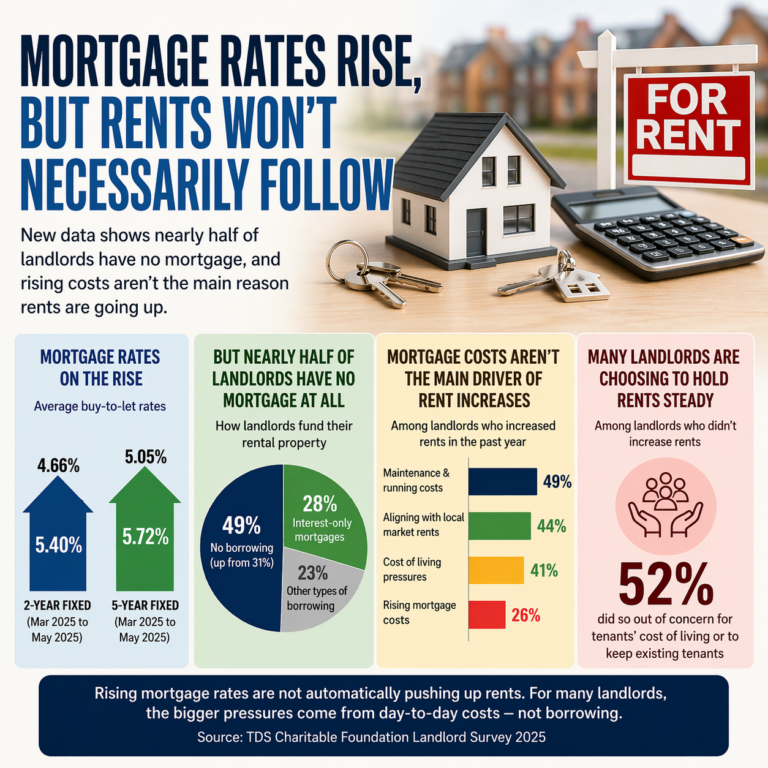
With rising buy to let mortgage costs back in focus after more than 1,300 products being pulled since the end of March, one organisation says that isn’t why rents are rising.
TDS Charitable Foundation points to Moneyfacts data showing that average BTL mortgage rates have climbed with two-year fixed deals jumping from 4.66% to 5.40%.
Five-year fixes have moved from 5.05% to 5.72% which is prompting familiar warnings that higher landlord borrowing costs mean higher rents for tenants.
But the Foundation warns that its research from its Voice of the Landlord Survey tells a less obvious story.
The Foundation says: “Last year, mortgage costs were not cited as the primary in determining rent increases.
“Among the 56% of landlords who said they have increased rents over the previous 12 months, just a quarter (26%) cited growing mortgage costs.
“More frequently cited reasons for increasing rents included increased property maintenance and running costs (49%), wanting to align rents with the local market (44%), and increases in the cost of living more generally (41%).”
The survey, which is based on more than 2,000 landlords in England, shows that 49% now own their properties outright.
In other words, nearly half the sector is insulated from mortgage rate movements altogether — a sharp rise from 31% the year before.
The Foundation adds that even where borrowing is involved, the picture isn’t uniform since 28% of landlords are on interest-only buy to let loans.
That leaves them more exposed as rate increases feed straight through into monthly costs without chipping away at the balance.
The organisation is claiming that rent setting by landlords is being shaped more by day-to-day economics than by financing costs alone.
However, among the 43% who did not increase rents, the most common reason, for 52%, was concern about tenants’ finances.
There was also a desire from landlords to keep existing tenants in place.
The Foundation says that, in reality, landlord behaviour appears more cautious than the headline narrative suggests.
It adds that the 2026 survey will provide a clearer picture of whether that balance begins to shift if borrowing costs remain high.
The TDS Foundation’s research has been reflected in Property118’s recent survey of landlords.
It found that most landlords are now operating with relatively modest borrowing levels.
That challenges the long-standing assumption that the sector is heavily leveraged and highly exposed to interest rate shocks.
Data from the Landlord Sentiment Survey Q1 2026, based on 2,380 responses, shows a majority of landlords have loan-to-value ratios at or below 50%.
A significant share own their properties outright, with no mortgage debt.
While landlords with higher borrowing remain sensitive to rate changes and refinancing pressures, they appear to represent a smaller segment of the market than commonly assumed.
4 comments on this article
A different perspective could help you spot an issue, avoid a mistake or find a better way forward. Read the comments and add your own views if you wish.
6 months ago | 1 comments
6 months ago | 2 comments

7 months ago | 5 comments
Member Since December 2023 - Comments: 1665
9:31 AM, 14th April 2026, About 6 months ago
I don’t have a mortgage. I increased my rents this year because of Labour’s policies and the risk of rent controls.
Member Since September 2015 - Comments: 240 - Articles: 1
10:36 AM, 14th April 2026, About 6 months ago
I have just increased mine for the first time in 5 years to bring them up to the “market rate” before the rules change. I feel sorry for my tenants but they have been on a low rent for a long time.
Member Since May 2024 - Comments: 173
11:29 AM, 15th April 2026, About 6 months ago
When interest rates rise, the cash invested in property has to be competitive with other, easier investments like bonds. Within 1% it doesn’t matter if you are a borrower or a saver. A part mortgaged house is going to be costing 5.5% for the borrowed bit and 4.5% for the saved bit (approximately). There is no such thing as being ‘insulated’ from higher rates especially when the costs and bureaucracy for landlords are making this more troublesome.
Member Since October 2022 - Comments: 277
4:46 PM, 16th April 2026, About 6 months ago
Very surprising statistics. Supposedly about 50% of BTL mortgages are repayment, and mortgaged property has gone from 69% to 51% of inventory in the course of just one year, so about 25% of BTL mortgages have been discharged in just one year. It would be extremely unlikely that these figures (if anywhere near to reality) could be caused primarily by repayment loans coming to a natural end. More likely, it would suggest that a lot of leveraged landlords are selling up because the mortgage and other costs are now simply too high to be sustainable.
But those landlords “insulated” from the vagaries of mortgage rates should consider whether an investment that is unable to cover the cost of financing it at market rates is a good place to leave their money, or whether they have other motivations for hanging onto their properties.