

3) When stability and flexibility begin to diverge
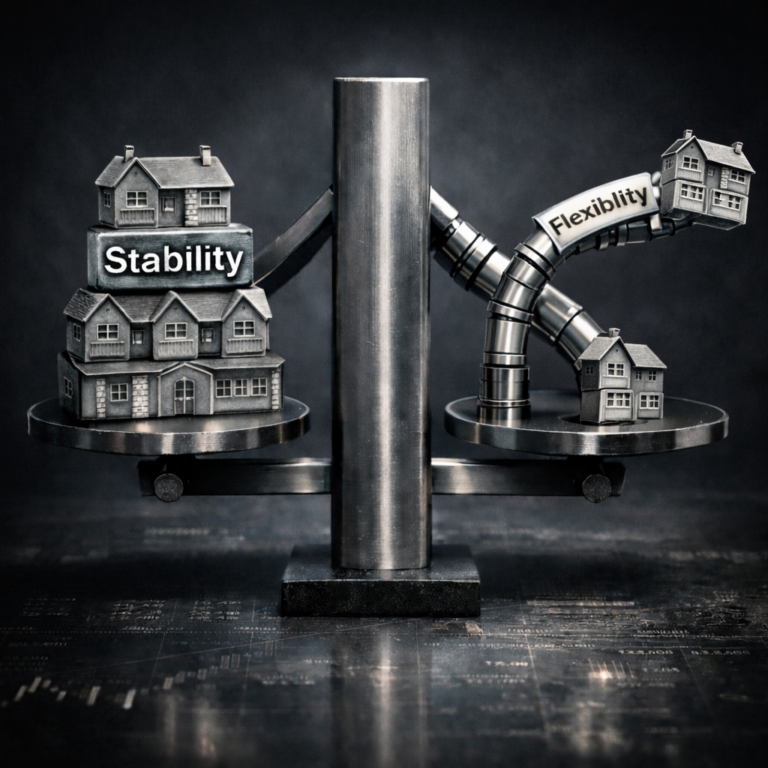

One of the most satisfying moments in a landlord’s journey arrives when the portfolio finally feels stable, rental income is predictable, borrowing is modest, voids are manageable, and the business begins to run with a rhythm that was much harder to achieve in the early years. For many experienced Property118 readers, this is the stage where the portfolio begins to feel dependable rather than demanding, and that sense of stability is well earned. It usually reflects years of careful acquisition, refinancing, and steady management, yet something interesting often becomes visible at precisely this point; stability and flexibility are not always the same thing.
The difference between stable and flexible
A stable portfolio continues operating successfully without requiring major changes. Rent arrives each month, lenders are satisfied, and the landlord knows the business can continue in roughly the same form for many years, but flexibility is something slightly different.
Flexibility describes how easily the portfolio can adapt if circumstances change. It reflects the ability to adjust income, create liquidity, transfer control, or respond to new priorities without disrupting the underlying assets. That’s why many portfolios achieve stability long before they achieve flexibility.
Questions that tend to emerge later
When landlords begin thinking about the next twenty or thirty years rather than the next refinance, a different set of considerations often appears.
If income needs change, how easily can the portfolio adapt?
If control needs to be shared or transferred, how straightforward would that be?
If liquidity is required at some point, how easily could it be created, especially later in life?
If circumstances change unexpectedly, how resilient is the structure around the assets?
None of these questions are particularly urgent while the portfolio continues operating comfortably, and that is why they are often left unexamined for long periods of time. The business continues to perform, and there is no obvious trigger to step back and reconsider the broader picture.
When the next phase begins to appear
Many landlords eventually reach a moment where the portfolio feels complete. The drive to keep acquiring begins to fade, and attention gradually shifts toward how the existing assets will support the next stage of life. For some investors, that means thinking about long-term income and financial security. For others it means considering family involvement, succession planning, or simply reducing the amount of day-to-day responsibility attached to the portfolio.
At that point, the conversation changes; the question is no longer how to build the portfolio, it evolves into how the portfolio should behave over the coming decades.
Why these questions are often postponed
One of the interesting characteristics of mature portfolios is that they rarely force immediate strategic decisions. The assets are already working, cash flow is steady, and borrowing is manageable. Without a clear trigger, it is easy to assume that the existing structure will continue serving the landlord’s needs indefinitely, and sometimes it does, yet many experienced investors discover that the most significant decisions about their portfolio arise not during the building phase, but once the building phase has already ended.
The earlier those decisions are considered, the more options tend to remain available.
A conversation that increasingly arises
Over the past year we have noticed a growing number of Property118 readers beginning to explore these questions. Interestingly, the portfolios involved are rarely under pressure. In most cases the landlords involved have built strong businesses with relatively modest borrowing and substantial equity, meaning that the motivation is not urgency; it is curiosity. They simply want to understand how their portfolio might evolve over the next twenty or thirty years, and whether the structure that served the growth phase of the journey will continue to serve the next phase equally well.
Those discussions always begin in the same place: understanding the portfolio in detail.
In the next article in this series, I will explore another issue that often becomes visible once portfolios reach maturity: why the strategy that built the portfolio is not always the strategy that protects it.
An invitation for established landlords
If you have reached a stage where your portfolio feels stable and you are beginning to think about the longer-term direction of your property business, we would be happy to take a look at your position.
BOOK A CONSULTATION
These conversations tend to be most useful for landlords with established portfolios and relatively modest borrowing who are beginning to reflect on how their assets could work differently in the years ahead.
|
★★★★★
|
Help other landlords find Property118If you have found Property118 useful, a short Trustpilot review would make a meaningful difference. It helps other landlords decide whether our research is worth following. |
Be the first to comment
Your experience could help the next reader
Have you dealt with something similar? Share what you learned, raise a question or offer a perspective your peers may find useful.
Not a member yet? Join In Seconds
Login with