

4) When the strategy that built the portfolio is no longer the strategy that protects it


Every successful landlord can usually describe the strategy that built their portfolio. In the early years the focus tends to be clear; find properties with strong long-term prospects, arrange sensible finance, and then allow rental income and capital growth to do their work over time. Then, reinvest the gains carefully and gradually expand.
For many Property118 readers, that strategy proved remarkably effective. Over the past twenty or thirty years, it has allowed ordinary investors to build substantial portfolios, often while working full-time in other careers. It is therefore perfectly natural to assume that the same approach will continue to serve the portfolio indefinitely, yet something interesting often happens once the portfolio reaches maturity.
The strategy that helped create the assets may not automatically be the strategy that best protects them.
The momentum of the growth years
During the expansion phase of a property business, most decisions are guided by opportunity and momentum. A landlord might focus on identifying undervalued properties, securing finance on favourable terms, and gradually increasing the scale of the portfolio. Each successful acquisition strengthens the business, equity grows, refinancing becomes easier, and the portfolio begins to develop its own financial momentum. At that stage, growth itself often becomes the organising principle. The next property, the next refinance, the next improvement project. For many investors this rhythm continues for years, sometimes decades.
When growth stops being the primary objective
Eventually, however, many landlords reach a point where the portfolio feels complete. The need to acquire additional properties diminishes. Borrowing may have fallen significantly, and the business may already be generating the income the owner originally hoped to achieve. This is often the moment when the strategic focus begins to shift. The question is no longer simply how to grow the portfolio. The question becomes how the existing assets should behave over the long term.
The new questions that begin to appear
Once landlords start thinking beyond expansion, a different set of considerations often comes into view.
Does the portfolio need to keep growing, or is its role beginning to change?
Is the current structure designed for the next twenty years, or mainly for the previous twenty?
If circumstances change, how easily can the business adapt?
How will the portfolio be managed if the I/we eventually step back?
These questions rarely arise suddenly. More often they emerge gradually as landlords begin thinking about the future of the business rather than its expansion.
Why success can make these questions harder
Ironically, the better a portfolio performs, the easier it is to postpone these discussions. If rents are stable, borrowing is manageable and the properties continue to appreciate, there may appear to be no reason to reconsider the strategy that produced those results, yet long-term wealth management is rarely static. The circumstances that existed when the portfolio was first built may not be the same as those that exist later in life. Families grow, priorities change, and the responsibilities attached to managing a large portfolio may eventually look different from the perspective of the person who created it.
None of this implies that the original strategy was flawed; in many cases it was extremely successful. The point is simply that strategies designed for accumulation do not always translate automatically into strategies designed for protection, transition or succession.
The stage many landlords eventually reach
Over time we see more landlords reaching this stage of reflection. The portfolio itself is not the problem, in most cases the properties are performing well and the underlying business is strong. The curiosity comes from somewhere else. Landlords begin to wonder whether the structure and direction of the portfolio still align with the future they now want. Those conversations rarely revolve around new acquisitions. More often they focus on the long-term role of the assets that have already been built.
Starting with the facts of the portfolio
Any meaningful discussion about strategy has to begin with understanding the portfolio itself. The number of properties involved, the borrowing arrangements, the ownership structure and the income profile all shape the choices available to the landlord. Without that context, strategic conversations remain theoretical: with it, they become much more practical.
In the next article in this series, I will look at another issue that tends to emerge once portfolios mature: why equity can sometimes become the least examined asset within a successful property business.
An invitation for established landlords
If you have built a substantial portfolio and are beginning to think about how the next phase of your property business should look, we are happy to take a look at your position.
BOOK A CONSULTATION
These conversations tend to be most useful for landlords with established portfolios and relatively modest borrowing who are beginning to reflect on how their assets could work differently in the years ahead.
|
★★★★★
|
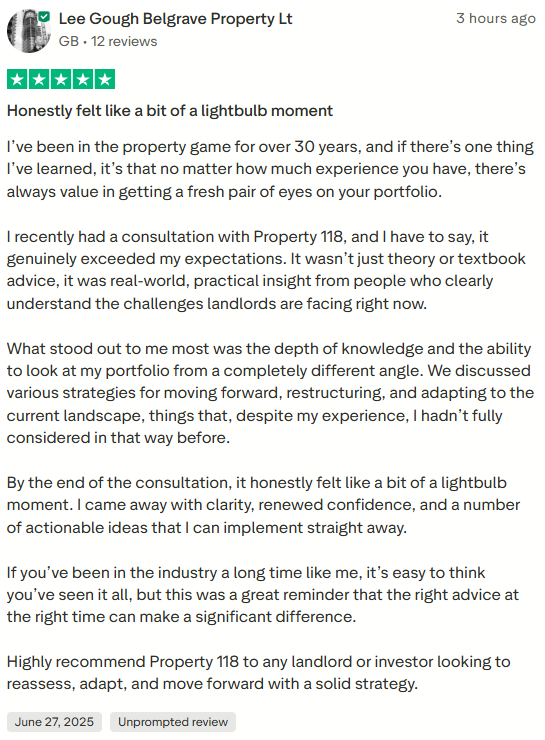
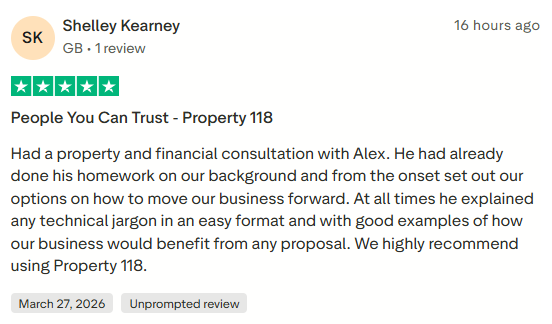
Help other landlords find Property118If you have found Property118 useful, a short Trustpilot review would make a meaningful difference. It helps other landlords decide whether our research is worth following. |
Be the first to comment
Your experience could help the next reader
Have you dealt with something similar? Share what you learned, raise a question or offer a perspective your peers may find useful.
Previous Article
3) When stability and flexibility begin to diverge
Not a member yet? Join In Seconds
Login with