

Open Letter to the SNP: why did Scotland’s PRS stop growing?
7 months ago | 8 comments


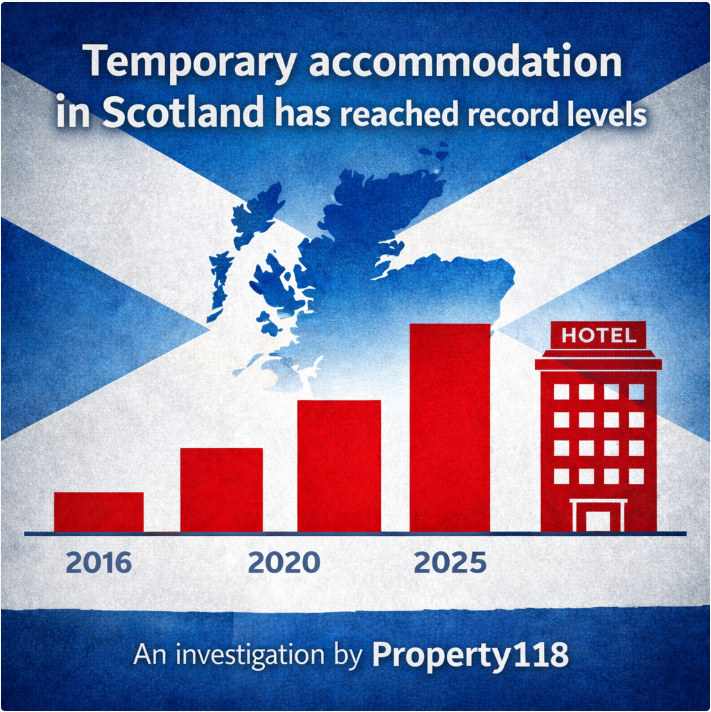
Housing crises rarely arrive overnight. More often they develop gradually, through a series of policy decisions and market changes that alter how housing supply behaves over time.
In Scotland, one of the clearest signals of growing pressure in the housing system can be found in a statistic that rarely receives the attention it deserves: The number of households living in temporary accommodation.
Official figures show that more than 16,600 households were living in temporary accommodation in Scotland by late 2024, with the number continuing to rise.
More than 10,000 children are now growing up in temporary housing while local authorities search for permanent homes.
At the same time, the amount of time families spend in temporary accommodation has increased significantly. The average duration has risen from 176 days in 2017–18 to around 238 days in 2024–25, meaning many households now spend most of a year in temporary housing before securing a permanent property.
These numbers tell us something important; the housing system is under increasing strain.
The question worth asking is simple.
What changed?
| Indicator | Mid-2010s | Latest figures |
|---|---|---|
| Private rented homes | ~370,000 | ~320,000 |
| Households in temporary accommodation | ~10,000 | 17,000+ |
| Children in temporary housing | ~6,000 | 10,000+ |
| Council spending on temporary accommodation | Rising | £100m+ annually |
Rising use of temporary accommodation does not only affect families; it also places growing pressure on local authority budgets.
New figures show Scottish councils spent more than £100 million in a single year on B&Bs and hostels alone to house homeless households.
That spending has increased dramatically in recent years. Between 2020–21 and 2024–25, spending on this type of emergency accommodation rose by 128 percent.
These costs are only part of the overall picture. Earlier investigations found Scottish councils had already spent over £660 million on temporary accommodation between 2012 and 2017.
Much of this money ultimately flows to private accommodation providers, including hotels, hostels and short-term rental properties. The result is an uncomfortable paradox. Large sums of public money are now being spent managing the consequences of housing shortages, rather than increasing housing supply itself.
Scotland is not alone. Across England, local authorities are also struggling with rising temporary accommodation costs.
Councils in England spent around £2.8 billion on temporary accommodation in 2024–25, reflecting a sharp increase in recent years as homelessness pressures have grown.
This comparison matters for one simple reason; the rise in temporary accommodation use is not simply a local administrative problem. It reflects structural pressures across the housing system.
Where housing supply fails to keep pace with demand, the result is almost always the same; more households end up in temporary accommodation.
Readers of Property118 may recognise this pattern. Several years ago, David Knox FCA, writing under the pseudonym Appalled Landlord, examined a statistic that appeared unusual at the time.
Manchester City Council’s spending on temporary accommodation had increased from roughly £2.25 million to almost £13 million in just five years.
At the time, the figure looked like a regional anomaly. Looking back now, it appears more like an early warning.
Across Britain, temporary accommodation costs have risen dramatically as housing supply pressures have increased. What once appeared to be an isolated local trend is now visible across multiple housing systems.
Temporary accommodation statistics do not exist in isolation; they sit at the end of a chain of events that begins much earlier in the housing system.
When housing supply expands, fewer households require emergency accommodation.
When supply contracts, the pressure tends to appear first in waiting lists, then in homelessness services, and eventually in temporary accommodation budgets.
That is why temporary accommodation statistics can act as an early indicator of deeper structural change in the housing market, and in Scotland, those indicators are now flashing brightly.
If temporary accommodation use is rising, the question is not simply how to manage it. The more important question is why the pressure emerged in the first place; what changed in Scotland’s housing system?
Did housing supply slow?
Did investment patterns shift?
Did regulatory or taxation changes alter the incentives that shape housing supply?
These are questions that deserve careful examination, because temporary accommodation statistics do not simply measure homelessness; they measure how effectively a housing system is functioning.
What keeps Property118 independent?
More than 3 million monthly Google search impressions now direct landlords towards our reporting and discussions.
We have created a new page explaining how readers help protect that independence and keep the platform focused on outcomes, not agendas.
1 comment on this article
A different perspective could help you spot an issue, avoid a mistake or find a better way forward. Read the comments and add your own views if you wish.
Previous Article
Rent growth returns as London leads rise
7 months ago | 8 comments

7 months ago | 31 comments
Member Since June 2019 - Comments: 973
1:54 PM, 16th March 2026, About 7 months ago
Don’t forget to add in the elephant of immigration into the mix – politicians are keen to keep attention away from that uncomfortable truth.