

7) Why the number of properties in a portfolio rarely tells the whole story


One of the most common ways landlords describe their portfolio is by the number of properties they own. It is a convenient shorthand. Someone might say they have five properties, ten properties, or twenty properties, and the listener immediately forms an impression of the scale of the business. For many years that simple measure works well enough. In the early stages of building a portfolio, the number of properties often reflects the level of activity, the amount of borrowing involved, and the degree of management required. However, as portfolios mature, that number begins to lose some of its meaning. The true complexity of a property business rarely lies in how many assets it contains, and more often, it lies in how those assets interact with one another.
When scale and complexity diverge
A landlord with two properties can sometimes face complicated financing arrangements, ownership structures, or family considerations. At the same time, another landlord may own fifteen properties that operate in a relatively straightforward way. The difference does not necessarily come from the number of buildings involved, it comes from the structure around them.
Over time, many landlords acquire properties in slightly different circumstances. One may have been purchased personally, another through a partnership, another later in life when tax rules had changed, and another after refinancing the earlier assets. Each decision may have been perfectly sensible at the time, yet the portfolio that eventually emerges can contain several layers of structure that were never originally intended to work together.
The questions that appear later
Once landlords begin thinking about the long-term direction of a mature portfolio, a different set of considerations often emerges.
How easily can the portfolio be understood as a single business?
Are the assets organised in a way that reflects the landlord’s current priorities?
Would someone else be able to step in and understand how the portfolio works?
How clearly does the structure reflect the future direction of the business?
These questions are rarely urgent; the portfolio may be functioning perfectly well on a day-to-day basis, and that is why they are often postponed.
Why complexity tends to accumulate quietly
Property portfolios are rarely built all at once, they evolve gradually as opportunities appear and circumstances change. Over the course of twenty or thirty years, tax rules shift, lending criteria evolve, family situations develop, and the landlord’s own priorities naturally move with time. Each decision taken along the way may have been entirely sensible in the moment. The result, however, can be a portfolio that reflects several different stages of the landlord’s life rather than a single coherent design. This is not unusual, in fact, it is extremely common among mature portfolios.
When clarity becomes valuable
Many experienced landlords eventually reach a stage where they begin to look at the portfolio as a whole rather than as a collection of individual assets. The properties themselves are familiar, the management processes are well established, so the curiosity lies elsewhere. Landlords begin to ask whether the structure surrounding those assets still reflects the future they now have in mind. For some investors the answer is reassuringly straightforward; the portfolio already aligns with their long-term intentions, whereas for others, it becomes clear that the assets were accumulated over many years without ever being examined together as a single strategic picture.
The moment many landlords recognise
This is often the point where the conversation begins to change. Instead of focusing on the next purchase or the next refinance, attention turns to the overall design of the portfolio itself. The landlord already understands how the business operates. The question becomes whether the structure surrounding the portfolio still serves the landlord’s broader objectives.
In the next article in this series, I will explore another question that often emerges once portfolios mature: why some of the most important decisions landlords make occur long after the last property was purchased.
An invitation for established landlords
If you have built a substantial portfolio and are beginning to think about the long-term direction of your property business, we would be happy to take a look at your position.
BOOK A CONSULTATION
These conversations tend to be most useful for landlords with established portfolios and relatively modest borrowing who are beginning to reflect on how their assets could work differently in the years ahead.
|
★★★★★
|
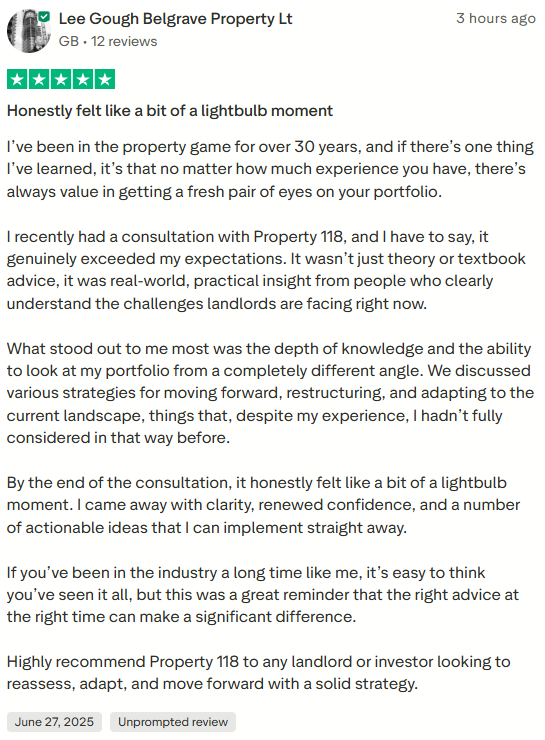
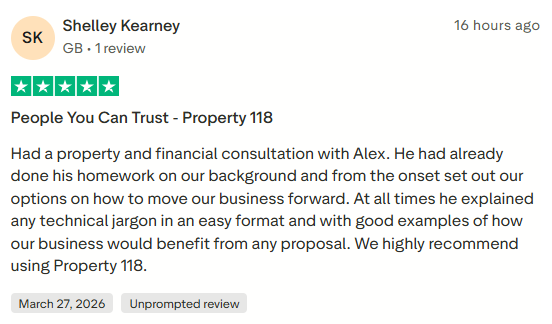
Help other landlords find Property118If you have found Property118 useful, a short Trustpilot review would make a meaningful difference. It helps other landlords decide whether our research is worth following. |
Be the first to comment
Your experience could help the next reader
Have you dealt with something similar? Share what you learned, raise a question or offer a perspective your peers may find useful.
Not a member yet? Join In Seconds
Login with