

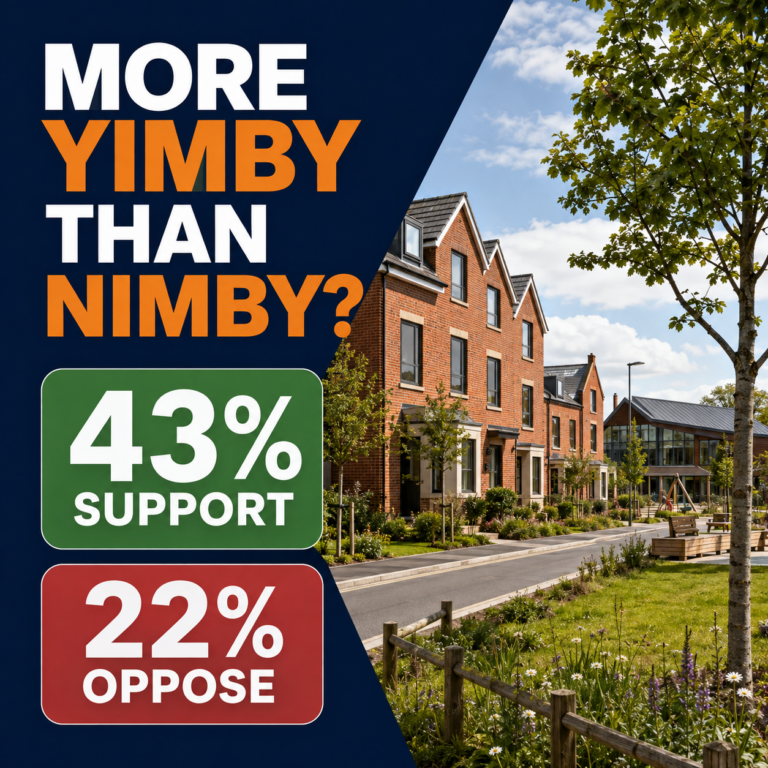

For years, anyone questioning a large housing development near their home has risked being dismissed as a NIMBY. New research from Barclays suggests that caricature is not just lazy. It is probably wrong. In the language of the housing debate, the UK may be far more YIMBY than NIMBY.
More than two in five UK adults support new homes being built within three miles of where they live. At 43%, support is nearly twice the 22% who oppose local development.
That is a significant finding. Support comfortably outweighs opposition, but that does not amount to a blank cheque for development without the GPs, roads, schools and infrastructure required to support it. The argument is not really about whether we build. It is about whether we build functioning communities or simply chase a national housing target.
support new homes being built within three miles of where they live
oppose new homes being built within three miles of where they live
Younger adults are the most supportive
Support is strongest among the generation facing the greatest barriers to home ownership. More than half of Gen Z adults support local housebuilding, compared with 48% of Millennials, 42% of Gen X and 37% of Baby Boomers.
Percentage supporting development within three miles of home
Opposition was 16% among Gen Z and 26% among Baby Boomers. Barclays did not provide the equivalent opposition figures for the two middle generations in the release.
Barclays reports that opposition rises with age, from 16% among Gen Z to 26% among Baby Boomers. Even among the oldest group reported, however, support remains comfortably ahead of opposition. That is not the picture usually painted when local residents are blamed for the housing shortage.
The regional divide is impossible to ignore
Northern Ireland recorded the strongest support at 53%, while Wales followed at 52%. Every region in the survey had more supporters than opponents, but the margin narrowed sharply in parts of southern England. In the South East, 36% supported local housebuilding and 35% opposed it.
That does not tell us why the South East is more divided, and the release does not provide regional sample sizes from which to judge whether small differences are statistically significant. It should, however, stop Westminster treating every housing market as though it faces identical pressures.
New homes being built within three miles of where respondents live
Northern Ireland
Wales
Yorkshire and Humberside
London
Scotland
North East
West Midlands
North West
East Midlands
East of England
South East
South West
Source: Opinium research for Barclays, 4 to 7 August 2026. Support and opposition do not add to 100%, and the supplied release did not break down the remaining responses.
The objections are not mainly about house prices
The most revealing part of the research is why people object. Among those opposing development, 61% are concerned about the loss of green space, countryside or natural habitat. Pressure on GPs, schools and other local services follows at 57%, with traffic and congestion at 55% and insufficient infrastructure at 52%.
Only 7% said they opposed development because it might reduce the value of their own home. That figure rather punctures the popular idea that opposition is mainly driven by selfish homeowners protecting their property values.
Percentage of people who oppose new homes locally citing each concern
These percentages do not form parts of a single 100% total.
People are looking at GP waiting times, overcrowded roads, school places and disappearing green space. Those are practical concerns about whether their community can absorb more development without becoming a worse place to live.
The message is hardly complicated: build the community as well as the homes.
There is also a clear route to winning more support. More than a quarter of opponents said additional GP and healthcare capacity would make them more likely to back local housebuilding. Investment in roads and infrastructure would persuade 18%, while 15% pointed to more green space and community facilities.
Promises hidden in planning documents are not enough. Existing residents need to see that essential services will be delivered when the new homes arrive, not discussed several years after the development has been completed.
Percentage of existing opponents who would become more supportive
Most commonly selected priorities for government over the next three years
Affordable housing tops the public’s priorities
When asked what the Government should prioritise over the next three years, 32% chose building more social or affordable housing. Reducing homelessness came next at 28%, followed by helping first-time buyers onto the housing ladder at 25%. For Gen Z, helping first-time buyers was the leading priority, cited by 29%.
There is no single housing crisis here. Some people cannot find a secure home, younger adults cannot raise a deposit, and established communities fear that already stretched services cannot cope with thousands of additional residents. Announcing another national housebuilding target will not solve all three.
A spare bedroom is not a spare home
Barclays also points to previous research which found that 85% of owner-occupied homes in England and Wales contain at least one spare bedroom. That statistic will inevitably tempt some politicians to start preaching about downsizing, but a spare bedroom is not the same thing as a spare home.
People cannot downsize into suitable, affordable properties that do not exist. High transaction costs, the upheaval involved in moving and a shortage of appropriate homes can all make staying put the rational choice. If the Government wants the existing housing stock to be used more efficiently, it needs to make moving worthwhile and ensure that the right homes are available.
Buying a home remains unnecessarily daunting
Building more properties will not automatically create greater housing mobility if buyers do not feel able to navigate the process. Six in ten adults said they were confident about buying a home, but 28% were not.
Among those lacking confidence, conveyancing and legal procedures and understanding taxes and fees were the biggest areas of uncertainty, both cited by 37%. Nearly a third cited paperwork and documentation. For Gen Z, the problems begin even earlier, with 39% citing saving a deposit and 36% saying they lacked confidence in understanding how much they could afford to borrow.
Percentage of adults lacking confidence in navigating the home-buying process
Houses still dominate mortgage completions
Barclays’ own July 2026 mortgage completions show that houses remain the dominant choice. Houses accounted for 81.7% of first-time buyer completions and 88.6% of other completions, with flats and maisonettes making up the balance.
That sits alongside earlier Barclays research which found 33% of recent Gen Z buyers had chosen what they regarded as a “forever home” so they would not have to move again. Across all buyers in that earlier survey, 27% intended to remain in their new home for at least ten years. The familiar assumption that younger buyers will simply climb through several rungs of the property ladder may already be out of date.
July 2026, shown as a percentage of completions in each buyer group
First-time buyer: 81.7% house, 18.3% flat or maisonette
Other buyer: 88.6% house, 11.4% flat or maisonette
These are Barclays mortgage completions, not all UK property purchases. Transaction volumes were not included in the release.
That does not mean every new development should consist of houses, but it is a useful warning. Housing demand cannot be satisfied simply by delivering any type of unit at any price and adding it to the national total.
What Barclays and Barratt Redrow said
“New homes are critical to easing tension in the housing supply, but attitudes towards development are nuanced. While UK consumers are broadly supportive of efforts to increase housing supply, this has to be in step with investment in local infrastructure, healthcare and transport links.
“Homeowners also need confidence that they can navigate the process of buying, selling and financing a move. Supporting mobility throughout the market, from first-time buyers getting onto the ladder to homeowners right-sizing into properties that better suit their needs, will be key to helping more people achieve their housing ambitions.”
“It’s really encouraging to see strong support for building more homes, particularly among younger people who face the greatest barriers to home ownership. With Gen Z the most supportive of local housebuilding, the findings highlight the importance of increasing housing supply for future generations.
“The research also confirms that people want development to be accompanied by investment in infrastructure and public services. That’s why housebuilders have such an important role to play, delivering not only the homes communities need, including affordable housing, but also funding and investing in local facilities that help communities thrive.
“Housebuilding is one of the UK’s most important economic drivers, creating jobs, supporting local businesses and generating investment in communities. With the right partnerships and local leadership, we can deliver growth that creates lasting social and economic value.”
The question planners cannot avoid
Patel and MacDiarmid are right that more homes matter, but this research is not a blank cheque for developers. It does not prove that every proposed scheme is appropriate or that local objections should be swept aside. It shows that support is far more common than opposition and that additional support can be earned when development leaves communities better served, rather than merely more crowded.
NIMBY and YIMBY are useful shorthand, but people do not necessarily belong permanently in one camp. The Barclays findings show that practical improvements can turn at least some opponents into supporters. The question ministers should be asking is not how to defeat the NIMBYs. It is whether the homes, healthcare, roads, schools and green spaces will be delivered together. If they are not, opposition is not irrational. It is the predictable response to development being done on the cheap.
Would you support hundreds of new homes being built within three miles of where you live? If not, what would need to be delivered first to change your mind?
About the data: Opinium Research carried out the consumer research for Barclays between 4 and 7 August 2026. The survey covered 2,000 respondents and was described as representative of UK consumers by age, gender, region and income. Barclays did not publish subgroup sample sizes, confidence intervals or the full answer sets in the supplied release.
The mortgage-completion figures are proprietary Barclays data for July 2026. The separate spare-bedroom figure comes from Barclays’ October 2024 report, The Right-sizing Revolution: Unlocking untapped capacity in the housing market.
Member Since December 2024 - Comments: 73
10:30 AM, 26th August 2026, About 2 months ago
Where are all the GPs, schools, roads and green spaces going to go? Where I live, everywhere is already built up. I have a pocket of land that could be developed into up to nine dwellings, but I fail to see where the corresponding infrastructure increase is going to occur, yet that will not stop me being charged the community infrastructure levy, which then simply becomes a tax on development along with the nutrient neutrality tax and BNG. I am sorry, but you will never convince me that the UK is business and developer friendly. There are too many disincentives what with high costs to doing business and excessive regulation, which is intertwined.
Member Since September 2022 - Comments: 218
9:12 AM, 30th August 2026, About 2 months ago
We live in the Crewe area
An old railway town with great transport links to the rest of the country both motorway and rail links !
HS2 Will come to Crewe one day.
Within 3 miles of Crewe town centre Thousands of new build homes have been built but this has put huge demand on schools, GP and hospital services, Dentists and other health services.
The town centre struggles to fill the empty shops yet the local shopping centre with FREE parking is packed every day.
No NIMBY,s in Crewe
No housing crisis in Crewe just lots of new homes.
Labour won’t build 1.5 million new homes in 5 years because people want to live in Big cities for Jobs and Leisure activities 🙄
Yet Council’s delays and Planning applications take Years to get permission to even start.
Funding is drying up in London and the South east due to high building costs ( Labour and materials )
Workers can’t afford the high mortgage rates and saving for a deposit.
Older and Younger Landlords are selling UP due to the Landlord Witch hunt now being pushed through the corridors of power in both Parliament and Local Left wing Councils.
Many people want or have to Rent in modern Britian yet the powers that be ignore this and want to Tax Private Landlords out of business