

Taxes, Spending and the Myth of the Binary Choice

A recent YouGov poll has been making the rounds on social media. It claims that 58% of voters want public spending maintained or increased, while 67% want taxes to stay the same or fall. The post summarising the data concluded with a neat, confident line:
“In reality, it’s a binary choice. Taxes go up, or spending is cut. That’s it.”
That phrase has been shared widely, yet it is fundamentally misleading. In economics, nothing is ever that simple. The idea that government finances operate as a binary trade-off between taxation and expenditure ignores the most powerful variable of all: growth.
The missing third option
Fiscal outcomes are not decided solely by how much tax is charged or how much government spends. They are shaped by the scale and productivity of the economy beneath those decisions. A country that grows its GDP faster than it grows public spending can sustain or even expand public services without raising tax rates.
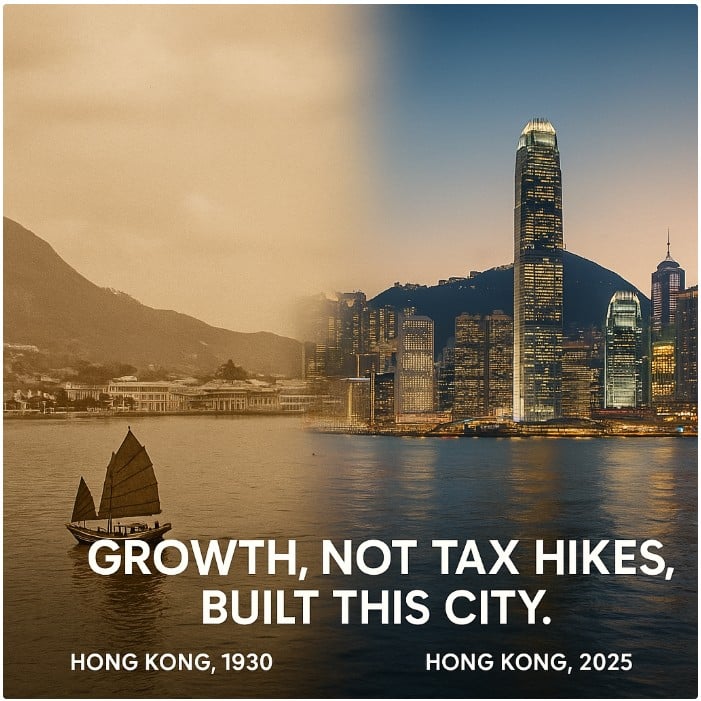
That is not a theoretical construct. It is exactly what happened in Hong Kong for half a century.
Lessons from Hong Kong
From the 1950s onwards, Hong Kong ran one of the simplest and most stable tax regimes in the developed world. It taxed individuals at a maximum rate of 15% and corporations at roughly 16.5%. There were no capital gains taxes, no VAT, and limited stamp duties.
Critically, the government paired this simplicity with discipline. Public expenditure was tightly controlled, and long-term infrastructure investment was prioritised over short-term subsidy. The result was extraordinary: between 1960 and 1997, Hong Kong’s GDP grew nearly tenfold, living standards surged, and the government consistently recorded budget surpluses.
Despite the low rates, tax revenues as a share of GDP remained healthy because the taxable base kept expanding. A broader economy generated more transactions, more profits, and more employment, all feeding back into higher receipts without raising rates.
This is the compounding effect of economic velocity. Prosperity grows the pie, and the state’s slice increases naturally.
Why the UK debate misses the point
In the UK, the tax burden has reached a seventy-year high, yet public satisfaction with services is falling. That suggests a deeper structural issue. The government already collects roughly 37% of GDP in taxes, one of the highest levels in British peacetime history. Raising rates further risks diminishing returns.
When voters say they want better public services but lower taxes, they are not being irrational. They are expressing frustration that the current system delivers poor value. A country with modest growth and heavy regulation cannot tax its way to prosperity. The only sustainable solution is to make growth easier.
That means reforming planning law, simplifying tax compliance, and removing friction for business investment. Every hour spent by a small firm navigating complexity is an hour not spent creating value. Streamline the system, and output rises, bringing more revenue without punitive taxation.
A political comfort blanket
The “tax or spend” narrative has persisted for decades because it offers political clarity. It allows governments to present a false choice: you either care about fiscal responsibility or you care about public services. In reality, successful economies balance both by fostering expansion rather than extraction.
Hong Kong’s experience is not unique. Ireland’s growth surge after cutting corporation tax in the 1990s followed a similar pattern. So did Singapore’s rise as a regional hub. Each jurisdiction proved that disciplined spending and pro-growth taxation can reinforce one another rather than conflict.
The real question
Instead of debating how to divide a static pie, policymakers should be asking how to make the pie bigger. That shift in mindset transforms the discussion from who pays more to how can we all earn more. Growth is not a slogan; it is a fiscal strategy.
A well-governed economy can fund robust public services through expansion, not austerity. The binary framing of tax versus spend may make for punchy graphics, but it is intellectually lazy and economically defeatist.
Hong Kong showed that prosperity itself can be the engine of redistribution. The UK would do well to remember that.
What are your thoughts on this?
Be the first to comment
Your experience could help the next reader
Have you dealt with something similar? Share what you learned, raise a question or offer a perspective your peers may find useful.
Not a member yet? Join In Seconds
Login with