

Do SIS arrangements breach mortgage terms and invalidate Section 162 relief?
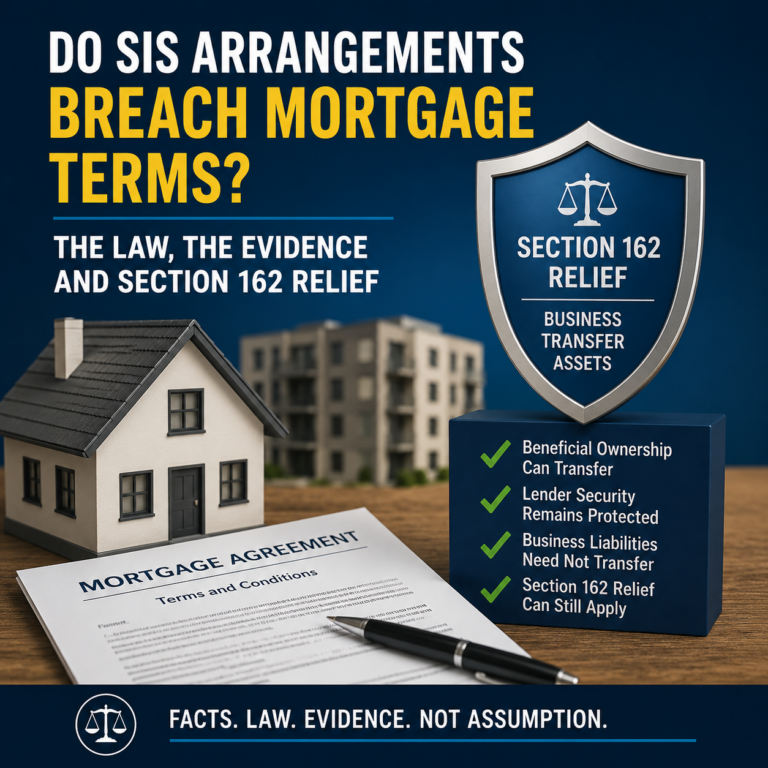

A criticism repeated against Substantial Incorporation Structure (SIS) arrangements is that transferring the beneficial ownership of mortgaged properties to a company must have breached the mortgage terms, making the transfer ineffective and automatically invalidating Section 162 Incorporation Relief. That argument compresses several separate legal questions into one convenient conclusion. The evidence heard during the ten-day DOTAS hearing demonstrates why each step must instead be proved.
The central point: a particular mortgage condition may have been breached in a particular case. That is not the same as proving that the beneficial interest did not transfer, that the lender lost its security, or that the statutory conditions for Section 162 relief were not satisfied.
The criticism, stated fairly
The criticism usually begins with an accurate description of one feature of the Substantial Incorporation Structure, generally known as SIS. The registered legal titles and existing mortgages remained in the names of the original property owners, while the beneficial ownership of the properties and the property business was transferred to their company.
From there, however, the criticism commonly proceeds through a chain of assumptions. It is said that lender consent must have been required, that the absence of consent must have amounted to a contractual breach, that any breach must have made the declaration of trust ineffective, and that the properties therefore remained personal assets. The final leap is that the “whole assets” condition in Section 162 of the Taxation of Chargeable Gains Act 1992 could not have been met.
Every link in that chain requires separate legal and factual analysis. None follows automatically from the one before it.
I do not suggest that mortgage terms are irrelevant. They are not. Nor do I suggest that every mortgage used by every SIS client necessarily permitted a transfer of beneficial ownership without consent. The responsible position is that the actual mortgage documents must be read and their legal consequences properly identified. What should not happen is for a generic lender criterion, a current set of standard terms or an unsupported assumption to be converted into an automatic Capital Gains Tax assessment.
The commercial problem SIS was designed to solve
The decision to separate beneficial ownership temporarily from legal title was not made in a commercial vacuum. Many landlords had spent years building portfolios financed across several lenders. Their existing mortgages frequently carried favourable interest rates, substantial early repayment charges and fixed-rate periods ending on different dates. Some lenders did not offer novation to a company at all, while replacing every mortgage simultaneously could involve arrangement fees, valuation fees, legal costs and materially higher interest payments.
The published DOTAS judgment, following the hearing from 2 to 13 February 2026, records extensive evidence about those commercial realities. At paragraph 160, the Tribunal summarised evidence from clients who wanted to preserve favourable mortgage rates, avoid early redemption penalties, manage administrative disruption and refinance gradually when it became commercially sensible.
The examples were not trivial. One client with 16 properties and six lenders estimated immediate refinancing costs of more than £150,000, together with an additional £20,616 a year in mortgage interest. Another had 35 mortgages and estimated costs of around £100,000. A further client faced an early repayment charge of more than £66,000 on just six mortgages, while another was advised to expect approximately £250,000 in refinancing costs. Several witnesses could not refinance some or all of their properties because of unresolved cladding problems.
Those clients had already identified their broader commercial objectives, including business continuity, succession planning, liability management, retirement planning and the ability to bring family members into a continuing business without dividing a portfolio property by property. Professional advice was used to test, document and implement their chosen direction. It did not manufacture the commercial problem that immediate refinancing would have created.
At paragraph 166, the Tribunal concluded that an informed observer could not reasonably regard obtaining Incorporation Relief as the single most important purpose of the overall SIS arrangements. It specifically identified the inability to refinance because of cladding, the desire to retain favourable mortgage terms, avoidance of early redemption penalties and the flexibility to refinance only when commercially advantageous as genuine non-tax reasons for the structure.
What the SIS documents actually did
Paragraph 20 of the judgment describes the SIS documentation. A sale and purchase agreement transferred the property business, its assets and liabilities to the company in consideration for shares. A declaration of trust provided that the former owners held the properties for the company and that the company indemnified them in respect of the existing mortgage debts. An agency agreement authorised the former owners to receive rents and pay expenses, including mortgage interest, as agents for the company. A property sale contract provided the mechanism for the legal titles to be conveyed later.
The documents did not purport to tell the mortgage lender that the company had replaced the original borrowers. The company’s indemnity was not a novation and could not bind the lender. The original borrowers remained personally liable under their mortgage contracts until the lending was refinanced or otherwise discharged.
That distinction is important. The company assumed the economic responsibility for the business liabilities as between itself and the former owners, but the lender retained its contractual rights against the named borrowers. The lender’s existing registered charge was not released or displaced. The company acquired its interest subject to that prior security.
HM Land Registry explains in Practice Guide 19 that competing interests generally rank according to the date of their creation and that an existing interest is not affected by a later disposition. A beneficial interest created after a registered mortgage does not somehow lift the property out of the lender’s security.
This does not mean a lender could have no contractual objection to the beneficial transfer. It means that the separate assertion that SIS destroyed or diluted the lender’s security requires considerably more than pointing to the existence of a declaration of trust.
Five questions that must not be rolled into one
A proper review of the mortgage and Section 162 position must distinguish between at least five questions:
- What did the particular mortgage contract say? The relevant documents are the mortgage offer, the edition of the conditions incorporated into it and any special conditions applying to that loan.
- Did the wording capture the transaction that actually occurred? A restriction on transferring the registered legal estate is not necessarily the same as a restriction on declaring a trust or transferring an equitable interest.
- If a term was breached, what legal consequence followed? The clause might give the lender contractual remedies, but the wording and applicable law must be examined before concluding that the transaction was incapable of taking effect between the owner and the company.
- Did the company become validly and absolutely entitled to the beneficial interest? That depends on the incorporation documents, their execution and the rights they actually created.
- Were the statutory conditions of Section 162 met? That is a tax question concerning the transfer of the business and its assets as a going concern in consideration wholly or partly for shares.
Evidence relevant to one question may also be relevant to another, but the questions are not interchangeable. Establishing a contractual default does not, without further analysis, establish that the trust was void. Establishing that a lender retained the right to demand repayment does not prove that the property business remained beneficially owned by the borrowers. Nor does the continued personal liability for mortgage debt prove that the “whole assets” requirement failed.
Birmingham Midshires: criteria are not the mortgage contract
A contemporaneous email exchange between Mark Smith and me concerning Birmingham Midshires is relevant to this debate, although I am not reproducing private legal correspondence here. Its narrower significance is that Birmingham Midshires was considered as a particular lender. It was not simply assumed that every lender and every mortgage product operated under identical wording.
The Birmingham Midshires websites illustrate why terminology matters. The lender publishes a page for its mortgage conditions, while its intermediary site separately publishes personal lending criteria and limited company lending criteria.
Those categories perform different functions. Lending criteria generally explain the types of new application a lender is prepared to consider. They may cover matters such as loan-to-value limits, rental cover, borrower age, portfolio size, income and property type. Mortgage conditions form part of the contractual framework governing a loan after it has been offered and completed.
A current lending criterion does not retrospectively amend a mortgage completed several years earlier. Nor does a current conditions booklet necessarily prove which edition was incorporated into a historic mortgage. To establish a breach, an adviser must obtain the actual offer and the precise conditions applying when that particular mortgage was entered into, together with any later agreed variations.
Even where several clients borrowed from the same lender, they may have completed under different products, different editions of the standard conditions or different special conditions. The lender’s name alone cannot answer the contractual question.
The Birmingham Midshires correspondence is therefore useful as evidence of a lender-specific enquiry, but it should not be exaggerated into a universal approval. The correct conclusion remains that Birmingham Midshires mortgages, like those of every other lender, must be reviewed by reference to the documents governing the individual loan.
Contemporaneous evidence that lender restrictions were recognised
It has sometimes been suggested that restrictions concerning beneficial ownership were either overlooked or concealed. The public record does not support that blanket allegation.
On 10 August 2017, I published an article entitled “Are CHL and Fleet’s mortgage terms prohibiting transfer of beneficial interest enforceable?” It explained that those were the lenders then known to us to include an express prohibition of this kind and warned that a borrower could technically be in default if such a lender discovered that the beneficial interest had been transferred.
That article was published openly on Property118 years before the present controversy. It does not establish what every lender’s conditions said, and it did not guarantee that no other lender had similar wording. It does, however, demonstrate that lender-specific restrictions were being identified, discussed publicly and distinguished from the position under other known mortgage terms.
The DOTAS judgment records the same distinction. At paragraph 87, evidence was given that statements about lender consent arose from checking lenders’ terms and that the outcome varied on a “case-by-case basis”. At paragraph 98, Dr Helmi candidly explained that mortgage conditions were not routinely examined separately for every mortgage in every client matter, but that there were known lenders expressly excluding transfers of beneficial interest and advisers were aware of them and advised accordingly.
That evidence should not be misrepresented in either direction. It does not establish that every mortgage received a comprehensive contractual audit. It equally does not establish that every mortgage was in breach or that lender restrictions were ignored. It confirms that the position was understood to depend on the lender and the relevant wording.
The evidence of material tailoring goes further. Paragraph 125 records a client with Paragon mortgages where those loans were novated to the company with the lender’s consent. The legal titles were transferred at the same time, and the properties subject to those mortgages were excluded from the trust arrangements. That is difficult to reconcile with an allegation that the same mortgage treatment was imposed indiscriminately regardless of lender requirements.
A contractual breach is not automatically a nullity
Suppose the actual mortgage conditions did expressly prohibit a declaration of trust or transfer of beneficial ownership without consent, and consent was not obtained. That may amount to a contractual default. It should be taken seriously because the lender may have remedies under the mortgage, potentially including refusing further advances, demanding repayment or enforcing its security.
The next question is still not answered merely by using the word “breach”. It is necessary to construe the clause and identify its legal consequence. Some provisions operate as promises by the borrower, with specified remedies if the promise is broken. Other provisions may be drafted in language intended to affect the efficacy of a disposition. Restrictions recorded on the registered title, leasehold alienation provisions and statutory requirements may raise further issues.
The party alleging that the beneficial transfer failed must therefore do more than establish that consent was required. They must identify the contractual wording, explain why it captured the particular beneficial transfer and establish why the legal consequence was that no effective interest could pass between the owners and the company.
That analysis cannot be replaced by a general observation that lenders dislike undisclosed changes. A lender’s commercial objection, a contractual event of default and the proprietary validity of a trust are connected issues, but they are not necessarily the same issue.
The lender remained protected
Under SIS, the original borrower remained liable for every payment due under the mortgage. The company’s indemnity did not release the borrower, amend the mortgage or remove any lender remedy. If the mortgage was not paid, the lender retained its rights against the borrower and the charged property.
The beneficial transfer was also subject to the lender’s pre-existing charge. HM Land Registry’s priority guidance confirms that an interest already in existence ordinarily ranks ahead of a later disposition. The company did not receive an unencumbered property and could not use the declaration of trust to defeat the lender’s security.
This is why two propositions can be true at the same time. A lender may object contractually to a transfer of beneficial interest, while its registered charge and its rights against the borrower remain intact. Demonstrating the former does not establish that the latter disappeared.
The judgment records witness evidence that hundreds, and possibly thousands, of properties were subsequently refinanced and conveyed into the relevant companies after SIS incorporation. It also records evidence that no lender had called in a loan solely on the alleged contractual breach, no insurer had rejected a claim for that reason and no possession judge had refused possession because SIS had been used.
Those were statements made by witnesses, not universal judicial findings that every mortgage complied with its terms. They nevertheless form part of the practical evidence. They do not sit comfortably with claims that the structure invariably destroyed lender rights, made later refinancing impossible or produced an inevitable enforcement event.
What Section 162 actually requires
Section 162 TCGA 1992 applies where a person transfers a business to a company as a going concern, together with the whole of the business assets or the whole of those assets other than cash, and the consideration is satisfied wholly or partly by shares issued by the company to the transferor.
HMRC summarises the conditions in its Capital Gains Manual at CG65710. Neither the legislation nor HMRC’s summary adds a freestanding condition that all business debts must be legally novated or that every secured lender must consent before Incorporation Relief can apply.
This is particularly important because mortgage debt is a liability, not an asset. The obligation to transfer the “whole assets” of the business does not mean that every liability must be transferred out of the original borrowers’ names.
HMRC’s own guidance at CG65745 states:
“The transferor is not required to transfer business liabilities to the company.”
The same guidance explains that a company commonly gives the transferor an indemnity in respect of the liabilities. HMRC’s published wording of Extra-Statutory Concession D32 also confirms that Section 162 relief is not precluded merely because some or all of the business liabilities are not taken over by the company.
That guidance directly addresses the proposition that Section 162 must fail simply because the original borrowers remained liable for their mortgages. HMRC says that business liabilities do not have to transfer and recognises a company indemnity as a normal mechanism.
The guidance does not settle every SIS enquiry. It remains necessary to establish that the business and all its relevant assets were genuinely transferred and that the other statutory conditions were met. It does, however, make it unsustainable to treat the name on the mortgage account as a complete test of entitlement to Incorporation Relief.
Beneficial ownership can transfer without registered legal title
The next issue is whether the property assets could be transferred for Capital Gains Tax purposes while the registered legal titles remained with the original owners. English and Welsh property law has long recognised the separation of legal and beneficial ownership.
HM Land Registry states in Practice Guide 24 that the register records ownership of the legal estate, not beneficial interests. It also explains that a disposition relating only to a beneficial interest cannot be registered because it does not alter the registered proprietors of the legal estate.
That is not evidence that a beneficial transfer has failed. It explains why the company’s name would not appear on the registered title following a beneficial-interest-only transaction.
A trust or disposition of an equitable interest in land must satisfy the relevant writing requirements in Section 53 of the Law of Property Act 1925. Whether an individual SIS declaration of trust met those requirements and made the company absolutely entitled depends on the deed and its proper construction.
For Capital Gains Tax, Section 60 TCGA 1992 provides that assets held by a nominee or bare trustee for someone absolutely entitled are treated as belonging to that beneficiary. HMRC explains at CG34320 that, where the beneficiary is absolutely entitled, the trustee and the trust are disregarded for Capital Gains Tax purposes.
The Chartered Institute of Taxation has also publicly observed that the tax rules generally focus on beneficial ownership and that many business incorporations have proceeded on the understanding that beneficial ownership can transfer while legal title remains with the transferor. The Institute nevertheless asked HMRC to clarify its Section 162 position, which is a fair acknowledgement that the precise application of the “whole assets” wording may be disputed. Its observations can be read in Tax Adviser magazine’s report on the CIOT’s 2024 representation.
The defensible position is therefore not that every document labelled a declaration of trust must be effective. The deed must have been properly executed, the company must genuinely have become absolutely entitled and the parties’ subsequent conduct must be consistent with the transfer. The defensible position is that retaining registered legal title does not, of itself, prove that the beneficial ownership or the property asset failed to transfer for Capital Gains Tax purposes.
The agency arrangements must also be understood
Some critics point to rent continuing to pass through a bank account in the former owners’ names or to mortgage payments continuing to be collected from that account. Those facts may be relevant, but they are not conclusive without considering the capacity in which the individuals acted.
The agency agreement described in the judgment expressly appointed the former owners to receive rent and pay property expenses on behalf of the company. Agency is a familiar legal relationship. Money does not become the agent’s beneficial income merely because the agent receives it, just as expenditure does not necessarily remain the agent’s economic cost merely because it passes through an account in the agent’s name.
The evidence should therefore include the agency agreement, company accounts, bookkeeping records, rent statements, tax returns, company bank movements and the treatment of expenses. If the parties ignored their documents and continued to operate the business personally, that could undermine the claimed transfer. Where the records and conduct consistently show that the company received the business income and bore the business expenses, the continued use of an agency account does not, by itself, reverse beneficial ownership.
Evidence from solicitors who completed later refinancing
The DOTAS hearing also included evidence from Jonathan Rose, a solicitor and partner at Harold Benjamin. Paragraphs 225 and 226 of the judgment record that he had been involved in more than 100 post-incorporation refinancing transactions in which legal title was transferred to the company after SIS or CAR had been used.
Mr Rose explained that some transactions occurred relatively soon after incorporation, but most took place months or years later when refinancing became commercially advantageous. Reasons included the expiry of early repayment charge periods, the availability of better interest rates and opportunities to raise further capital. His firm was on the panels of a large majority of lenders, including mainstream and smaller commercial lenders.
Again, that evidence does not establish retrospective lender consent in every case. It does demonstrate that the split between legal and beneficial ownership was capable of being brought to an end through mainstream conveyancing and refinancing processes, and that this happened in a substantial number of real client cases.
It also supports the documented advice recorded at paragraphs 63 and 64 of the judgment. Clients were advised to move the lending and legal titles into the company as soon as it made commercial sense, rather than leaving the split in place indefinitely. SIS was therefore a method of managing the timing and cost of refinancing, not an assertion that legal title and lender-facing liabilities should remain personal forever.
What the DOTAS judgment did not decide
The limits of the judgment must be stated clearly. The First-tier Tribunal was deciding whether SIS and CAR were notifiable arrangements under the DOTAS legislation. It allowed the appeals and cancelled the Scheme Reference Numbers, but it was not hearing hundreds of individual appeals concerning Section 162 relief.
The Tribunal did not declare that every SIS client qualified for Incorporation Relief. It did not construe every mortgage contract, validate every declaration of trust or rule that every client complied with every lender condition. Individual HMRC enquiries and assessments remain fact-specific.
That limitation cuts both ways. It is wrong to present the DOTAS victory as blanket judicial approval of every client’s tax position. It is equally wrong to imply that the Tribunal decided, or was presented with an agreed fact, that the arrangements breached mortgage terms and failed Section 162. It did neither.
What the judgment does provide is a detailed public record of the documents, advice processes, lender-related evidence, commercial refinancing constraints and subsequent conveyancing experience. The Tribunal considered the individual witnesses carefully following cross-examination and, at paragraph 262, found them overall to be honest and credible, while recognising that some were inconsistent, mistaken or did not fully understand every consequence.
An unresolved issue cannot properly be presented as though it has already been judicially determined against the clients.
Ramsay does not create a lender-consent condition
The mortgage argument is sometimes accompanied by a general appeal to the Ramsay principle or to “substance over form”. Those expressions do not permit the legal documents to be ignored, nor do they allow a condition absent from Section 162 to be inserted into the legislation.
In MacNiven v Westmoreland Investments Ltd, the House of Lords explained that the court must identify the legal nature of the transaction and then apply the statutory language, construed in its context and purpose. Ramsay is not a freestanding power to replace the actual legal rights created by a transaction with an impression of what supposedly happened underneath them.
Applied here, the substance includes the business sale agreement, declaration of trust, company indemnity, agency agreement, shares issued, accounting treatment, receipt of rents, payment of expenses, continued mortgage security and later refinancing. Looking only at the name printed on the mortgage statement is not a complete analysis of legal or commercial substance.
If the company never became absolutely entitled, if the documents were not validly executed, if a transfer remained conditional and never completed, or if the parties continued to treat the business as personally owned, Section 162 could be vulnerable. Ramsay does not, however, turn lender consent into an additional statutory condition or establish that personal mortgage liability prevents a beneficial transfer.
What a proper individual review should examine
Where an adviser or HMRC relies on mortgage terms as a reason for denying Incorporation Relief, the review should begin with evidence rather than assumptions. At a minimum, it should examine:
- the original mortgage offer, incorporated conditions and special conditions applying on the incorporation date;
- the precise wording of any restriction concerning legal title, beneficial ownership, trusts, assignments or changes of control;
- whether consent, notification, waiver or subsequent lender knowledge can be evidenced;
- the contractual and proprietary consequences said to follow from any breach;
- the executed business sale agreement, declaration of trust, agency agreement and related documents;
- whether the company became absolutely entitled to the property interests and the other business assets;
- the shares issued and any other consideration given for the business;
- the company’s accounts, rent records, expenditure, tax returns and actual operation of the business; and
- any subsequent refinancing, conveyance of legal title or other conduct confirming how the parties treated ownership.
Only after that analysis can an adviser responsibly reach a conclusion about the mortgage contract, the beneficial transfer and Section 162. A generic opinion based on another borrower’s conditions or a lender’s present-day criteria cannot replace the exercise.
Conclusion
It is entirely possible that a particular SIS client was subject to a mortgage clause that restricted the transfer of beneficial ownership and that consent was not obtained. That possibility should be investigated, not dismissed. The lender may have had contractual remedies and the client may require specialist advice about the consequences.
What does not follow automatically is that the declaration of trust was void, that the company acquired nothing, that the lender’s security disappeared or that Section 162 relief failed.
The statute requires the transfer of the business and its assets as a going concern in consideration wholly or partly for shares. HMRC’s own guidance expressly confirms that business liabilities need not be transferred and recognises the use of a company indemnity. Property law recognises the separation of legal and beneficial ownership, while Capital Gains Tax legislation may disregard a bare trustee where the beneficiary is absolutely entitled.
The DOTAS evidence demonstrates that lender terms were understood to vary, that known prohibitions were identified, that arrangements could be materially modified for particular lenders and that clients had powerful commercial reasons for deferring refinancing. It also records substantial practical evidence of legal titles and mortgages later being transferred into the companies.
The correct conclusion is therefore neither that mortgage terms never mattered nor that every reference to lender consent destroys Incorporation Relief. The correct conclusion is that each mortgage, each transfer and each Section 162 claim must be examined on its own documents and facts.
A possible mortgage default is not a self-executing Capital Gains Tax assessment. Considerably more legal and factual analysis is required before anyone can responsibly conclude that the business was not transferred or that Section 162 relief failed.
Primary and supporting sources
- Property 118 Limited & Anor v HMRC [2026] UKFTT 1111 (TC)
- Section 162, Taxation of Chargeable Gains Act 1992
- HMRC Capital Gains Manual CG65710: conditions for Incorporation Relief
- HMRC Capital Gains Manual CG65745: transfer of business liabilities and ESC D32
- Section 60, Taxation of Chargeable Gains Act 1992
- HMRC Capital Gains Manual CG34320: bare trusts and absolute entitlement
- HM Land Registry Practice Guide 24: private trusts of land
- HM Land Registry Practice Guide 19: priority of interests
- Section 53, Law of Property Act 1925
- CIOT representation concerning beneficial ownership and Section 162
- MacNiven v Westmoreland Investments Ltd
- Birmingham Midshires mortgage conditions
- Birmingham Midshires personal lending criteria
- Birmingham Midshires limited company lending criteria
- Property118’s contemporaneous 2017 article concerning lender restrictions
This article provides general information about English and Welsh property law, mortgage contracts and Capital Gains Tax. It is not a substitute for advice on a particular mortgage, declaration of trust, incorporation or HMRC enquiry. The documents and conduct in each individual case require specialist review.
Be the first to comment
Your experience could help the next reader
Have you dealt with something similar? Share what you learned, raise a question or offer a perspective your peers may find useful.
Previous Article
Andy Burnham faces rough sleeping challenge as figures rise
Not a member yet? Join In Seconds
Login with