

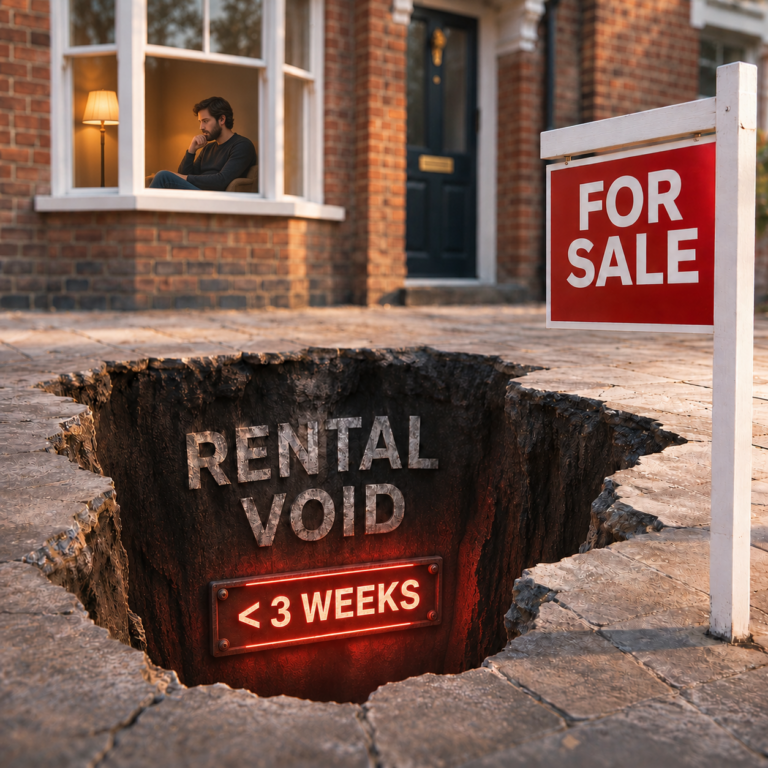
My average rental void when selling has been less than three weeks

Keeping rent coming in during a sale can protect both your bank balance and your negotiating position. The work that makes that possible often begins while the tenant is still settled in their home.
I have now sold more than 90% of my rental properties, without heavily discounting them! Across those sales, my average rental void has been less than three weeks.
That is the average period without rent, rather than the time taken to sell. A sale can take months or more, and somebody has to fund the property throughout that process.
That’s why my approach has been to consider the tenant, the likely buyer and the sale timetable together. That creates possibilities which are easily missed if the selling plan only begins when the tenant hands back the keys.
Once the tenant leaves, the clock starts
A familiar plan is to wait until a tenant moves out, freshen up the property and then put it on the market. The attraction is understandable. There is nobody to arrange viewings around, and a buyer can see that the property is available to move into. However, the void starts before the first viewing. There may be decorating, repairs and photographs to organise. Then comes finding a buyer, followed by mortgage arrangements, searches and legal work. If the buyer withdraws, the bills continue while you look for another one.
For illustration, a property renting for £1,250 a month loses £7,500 of gross rental income during a six-month void. Some letting expenses may fall away, but mortgage payments, insurance and any continuing service charges still have to be funded. The landlord may also pick up bills previously met by the tenant.
These can include council tax, energy standing charges even when nothing is being used, and the cost of heating, inspecting and maintaining an empty home. Extended vacancy can also affect insurance cover, so the policy needs checking.
There is an emotional cost too. Each delay becomes another period to fund, another visit to organise and another reason to worry about when the sale will finally complete.
An empty home can mean double council tax
In England, ordinary council tax usually remains payable on an empty home, although local discounts or exemptions may apply. Once it has been unoccupied and substantially unfurnished fora certain period, a council can impose a 100% premium, doubling the normal bill.
Qualifying properties actively marketed for sale may receive an exception from the premium for up to twelve months. Ordinary council tax usually still applies, and marketing before the premium starts can count towards that limit. Keeping a property advertised does not provide indefinite protection.
Restricting the buyer pool has a cost too
The other approach is to advertise solely as a tenanted investment, with the purchaser taking over the tenancy. That can work where the property, rent and price suit an investor. However, it largely excludes people looking for a home to live in themselves.
An NRLA survey reported in October 2026 found that 55% of respondents planned to sell some or all of their portfolio, compared with just 4% planning to buy. Those are respondents’ intentions, but they give sellers a reason to think carefully before relying entirely on another landlord to purchase.
An investor will assess the rent, costs, financing and return. If those figures only work at a substantially lower purchase price, that is likely to be reflected in the offer.
There is a crucial distinction here: marketing a property while it is occupied does not necessarily mean selling it with the tenancy continuing. A sale to someone who wants to live there may still be possible, provided there is a credible, lawful plan for vacant possession. Selling the property does not itself end the tenancy.
The tenant can be part of the solution
The starting point for my approach is to understand what a sale means for the person already living there. They may be able to buy. They may prefer an investor to take over. They may be willing to move if the arrangements give them enough certainty and a worthwhile reason to cooperate.
Cooperation has a commercial value. It can help with presentation, viewings and timing. A carefully structured incentive may make sense when considered against the rental income you could preserve and the unnecessary disruption you could avoid.
A buyer who needs vacant possession also needs confidence before spending money on the purchase. A vague suggestion that the tenant will probably leave is unlikely to provide that. The arrangements need to be realistic, voluntary and properly documented.
The detail is where the work sits: how to approach the tenant, what to offer, which conditions matter, and how to coordinate the move with the sale. Those decisions need to fit the actual property and the people involved.
Plan the sale before the void begins
If you are considering selling, or have already tried without success, a property sale consultation gives us the opportunity to work through your circumstances. We can consider the likely buyers, your tenant’s position and how to create a practical route towards completion.
I can explain the method behind my results, including the reasoning behind the incentives and written arrangements, so that you can consider how it could apply to your own sale.
My objective is to help landlords sell with minimal emotional and financial friction, while keeping avoidable rental voids as short as possible.
One-to-one property sale consultations are available at £400 per hour plus VAT.