

Councils collect just a quarter of landlord fines – NRLA
3 months ago | 1 comments


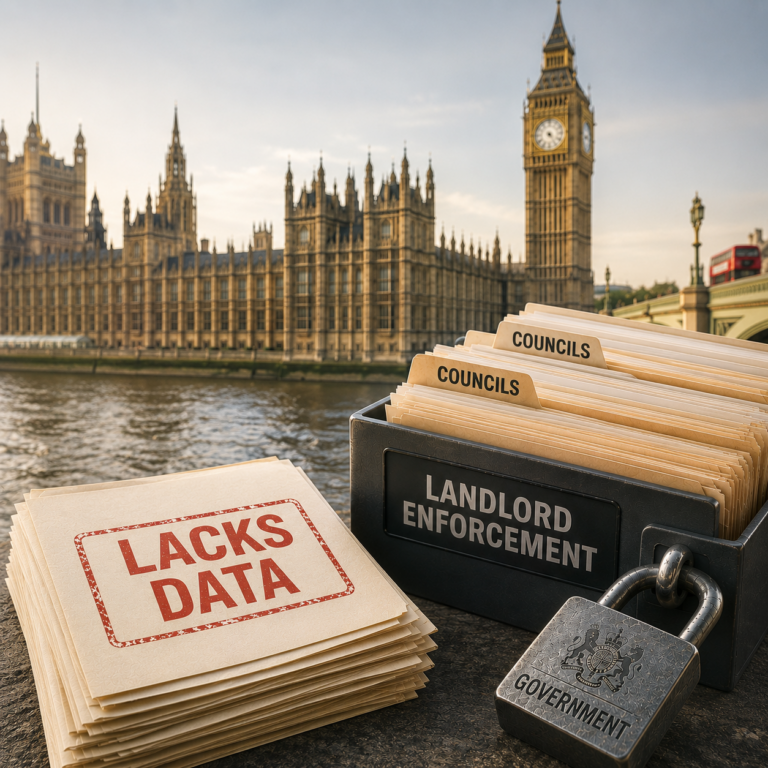
The government has admitted it does not collect data on how enforcement action against landlords has changed over the past five years.
In a written parliamentary answer, Housing Minister Baroness Taylor of Stevenage confirmed the government will require councils to submit enforcement data from April next year.
Under the Renters’ Rights Act, councils in England received £41 million to pay for their new enforcement powers.
Lord Young of Cookham asked the government: “What estimate they have made of the number of local authorities which have increased enforcement action against landlords in the private rented sector in each of the last five years and what assessment they have made of the resources available to local authorities for enforcement”.
In response, Baroness Taylor of Stevenage said: “The Ministry of Housing, Communities and Local Government (MHCLG) does not currently collect data that would enable an assessment of changes in enforcement activity against landlords at local authority level over the last five years. From April 2027 we intend to require local authorities to provide MHCLG with a suite of data on the private rented sector in their local area.
“We expect that data to include, for example, the number of formal enforcement notices issued; the number of civil penalties issued by category of offence; revenue received from civil penalties; total number of staff in private rented sector enforcement teams; and total spend on private rented sector enforcement.
“Through the Renters’ Rights Act, the government is strengthening local authorities’ enforcement powers and extending and increasing ring-fenced civil penalties to support a ‘polluter pays’ approach to enforcement in the private rented sector.
“In accordance with the new burdens doctrine, we will ensure additional net costs on local authorities resulting from the Act are fully funded. To that end, the Department is providing £41.12 million to local housing authorities for this financial year to help them undertake their new enforcement responsibilities. This funding is in addition to the £18.2 million provided in 2025/26.
“Our intention is to use fees from the Private Rented Sector Database to provide funding over the long term for local authorities to use on work to improve compliance in the private rented sector”.
As previously reported by Property118, the government says the PRS Database fee will be “fair and proportionate” and has hinted at combining the registration process for the PRS Database and the Ombudsman, but has not confirmed whether landlords will need to pay separate fees for each.
Councils will also gain the power to take enforcement action against landlords who fail to register on the PRS Database.
If a landlord lets or advertises a property without it first being registered on the database, they can be issued with a civil penalty of up to £7,000 or a £40,000 fine if they provide fraudulent information to the database.
3 comments on this article
A different perspective could help you spot an issue, avoid a mistake or find a better way forward. Read the comments and add your own views if you wish.
3 months ago | 1 comments


3 months ago | 7 comments
Member Since October 2025 - Comments: 23
10:38 AM, 6th August 2026, About 2 months ago
I’m confused. What about the licence fees councils are receiving? From Landlords? Isn’t that already supposed to be funding the councils’ enforcement actions?
Anyone have any ideas? Perhaps that all just goes on fancy biscuits and staff perks. Or to try to plug holes in their budgets. Which as we know are more plentiful than potholes.
Where is the public able to see what the councils are doing with the many millions they are reaping from rental licences?
It seems that When fees will also be compulsorily charged for the database Landlords will be forced to pay TWICE for exactly the same thing. How can this be justified?
Member Since November 2019 - Comments: 208
11:24 AM, 6th August 2026, About 2 months ago
£7000 fines £40000 fines For private Landlords whilst they let the Criminals out .
(Sorry for the mistake we are the Criminals)
Member Since December 2023 - Comments: 25
2:12 PM, 6th August 2026, About 2 months ago
Reply to the comment left by Northernpleb at 06/08/2026 – 11:24
We need to speak plainly. What is happening right now is not just unfair — it is dangerous. The people writing the laws that govern our sector are not following those laws themselves, and the consequences for us, and for tenants, are becoming severe.
We are watching a government that talks about integrity while behaving in ways that raise serious questions. When powerful figures receive expensive suits, dresses, glasses, and favours from influential donors, we must ask what is happening behind the scenes. And more importantly, why these same individuals are creating legislation that punishes responsible landlords while protecting and encouraging to be dishonest to a very tiny minority of problematic tenants.
The new legislation is being sold as “tenant protection,” but it will end up hurting the very tenants it claims to defend. Good tenants will face rising rents. They will face shrinking housing supply. They will face small landlords leaving the market or going bankrupt. And all of this is happening while some of the architects of these laws such as the Ex-chancellor or the ex-deputy Prime minister allegedly fail to register their own rental properties, fail to pay required licence fees, or face questions about unpaid taxes.
If they cannot follow the rules they impose on us, what does that tell you about the future of this sector?
We are being pushed into a corner. Every new regulation, every new penalty, every new licence fee is tightening the noose. And while we struggle to comply, those who wrote the rules appear to operate under a different standard. That double standard is not just hypocrisy — it is a threat to the stability of the housing market.
Landlords can not just give a month notice and leave. They have to abandon their investment that takes more than a month to leave as they are already and as supply collapsing although you will not notice by reading the Housing minister’s comment or by NRLA our landlord organisation as they are just to throw in more petrol so their business empire can increase even more. Rents will rise. And tenants — the good tenants — will suffer the most.
This is not speculation. It is already happening for several month now.
So today, I am not here to simply express frustration. I am here to issue a warning. If we do not stand together, if we do not speak out, if we do not challenge the unfairness and the inconsistency at the heart of this legislation, we will lose our savings and investment as well as the ability to provide homes at all.
We are not criminals. We are not the problem. We are the ones keeping the housing market alive. But we cannot survive under rules that are designed without honesty, without fairness, and without accountability. Obviously the Housing Minister paid an awful lot of money to do PhD but he failed it so is now bringing his educational frustration failure on small landlords and 98% of good tenants.
The message is simple: if ministers want strict rules, they must follow them too. If they want penalties, they must pay them too. If they want honesty, they must demonstrate it.
Our sector is at risk. Our livelihoods are at risk. And tenants’ futures are at risk.
This is the moment to act, to unite, and to warn everyone — landlords and tenants alike — that the current path leads to collapse by a bunch of careless opportunists.
Thank you.