

Section 21 cases fell ahead of abolition claim government
4 months ago | 1 comments


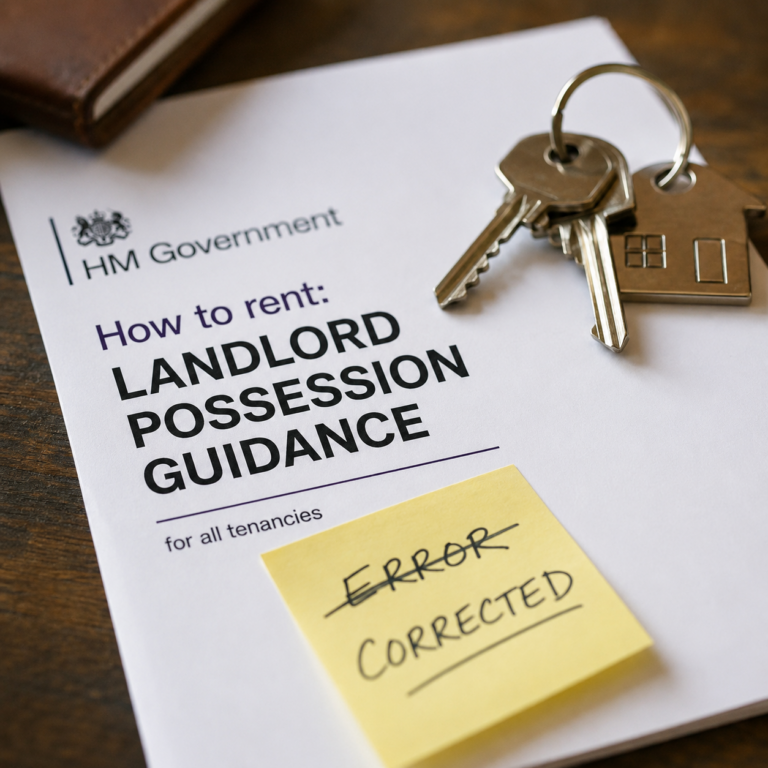
The government has corrected its official possession guidance after wrongly suggesting that landlords could have used the sale of a property as a Section 8 ground before 1 May 2026.
The error has now been quietly removed.
However, it comes as landlords relying on notices served under the old possession system face a fast-approaching deadline to begin court proceedings.
The Ministry of Housing, Communities and Local Government updated its guidance for England on 15 June, stating: “Removed ground for selling the property as it does not apply before 1 May 2026.”
Before the Renters’ Rights Act reforms took effect, there was no general Section 8 ground allowing a private landlord to recover possession simply because they wanted to sell.
Landlords intending to dispose of a property would usually have relied on Section 21, provided the notice was valid and all the relevant legal requirements had been met.
The new mandatory selling ground introduced under the reformed possession system applies to notices served from 1 May 2026.
It cannot be used retrospectively to support a notice served before that date.
The corrected guidance now lists examples of the grounds that could have been used in a pre-May Section 8 notice.
They include rent arrears, damage to the property, antisocial behaviour and breaches of the tenancy agreement.
It also refers to cases where the landlord needed to move back into the property or where the home was being repossessed by a mortgage lender.
Selling the property is no longer included.
The amendment does not change the law, but it removes potentially misleading advice at a time when landlords and tenants are navigating two possession systems.
Notices served before 1 May are governed by the previous rules, while notices served from that date must comply with the new Section 8 regime.
Landlords who served a Section 8 notice before 1 May must generally begin possession proceedings within 12 months of serving it or by 31 July 2026, whichever date comes first.
If that deadline is missed, the notice expires and cannot be used to begin a court claim.
The landlord must start again using the new grounds, forms and notice periods introduced on 1 May.
However, different limits apply to old Section 21 notices.
A landlord can normally begin proceedings only up to the earlier of 31 July 2026 or six months from the date the notice was served, although some periodic tenancies may be subject to a different validity period.
The guidance also warns that where a tenant’s required notice period runs to 31 July or later, the landlord will not be able to begin Section 21 proceedings before the transitional deadline.
The government has also made a separate amendment to the guidance on 11 June to clarify that tenants remain liable for rent throughout the notice period.
It now states that a tenant who leaves before a Section 8 or Section 21 notice expires will still need to pay rent until the notice period ends.
However, landlords and tenants may agree an earlier end to the liability.
The guidance suggests a landlord might agree to write off arrears where a tenant leaves voluntarily, avoiding the time and cost of court proceedings.
Landlords should ensure that any such arrangement is recorded clearly in writing, including the agreed date on which the tenancy and rent liability will end.
The correction gives landlords another reason to review any possession notices served before 1 May.
An old notice cannot be rescued by referring to one of the new possession grounds.
Its validity will depend on the law, prescribed form, grounds and notice periods that applied when it was served.
Landlords planning to rely on a pre-May notice should also check the final date for issuing proceedings rather than assuming every notice remains usable until 31 July.
Be the first to comment
Have you dealt with something similar? Share what you learned, raise a question or offer a perspective your peers may find useful.
Previous Article
Bank of England rate hold brings stability to housing marketNext Article
Coastal house prices plunge by up to 38%
4 months ago | 1 comments

4 months ago | 5 comments

5 months ago
Not a member yet? Join In Seconds
Login with