
Property118 highlights HMRC manual SDLTM07700 in ongoing FTT debate
8:48 AM, 14th April 2026, 2 months ago
Categories:
There is a recurring assumption in recent commentary that tax consequences only arise once legal ownership of property has formally transferred. It is an understandable assumption, but it is also, in many cases, incomplete.
As the ongoing First-tier Tribunal in the DOTAS case of Property118 vs HMRC examines the interaction between incorporation, financing, and tax treatment, it is worth revisiting what HMRC’s own guidance actually says about when a transaction is recognised for tax purposes.
What HMRC says about “substantial performance”
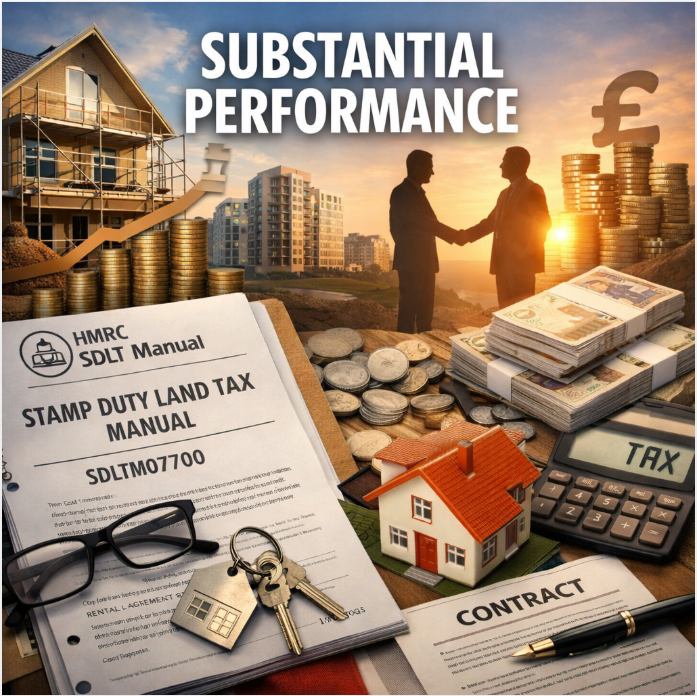
HMRC’s Stamp Duty Land Tax Manual confirms that a transaction can be treated as having taken place before legal completion, where a contract has been substantially performed.
The guidance is set out here: https://www.gov.uk/hmrc-internal-manuals/stamp-duty-land-tax-manual/sdltm07700
In simple terms, where substantial performance occurs, the contract itself is treated as the effective transaction for tax purposes, even if legal title has not yet transferred.
HMRC goes on to explain that substantial performance can arise where, for example:
- possession of the property is taken, or
- rents or income begin to flow to the acquirer (e.g. tenant begins paying rent into the acquiring company bank account), or
- consideration has been paid in a way that reflects the economic reality of the arrangement (e.g. issue of shares or share premium)
This is not an obscure or newly developed concept; it has been part of the UK tax framework for many years.
Why this matters in the current debate
The relevance of this guidance is not that it proves any particular structure is effective, it is that it highlights a broader and well-established principle: tax law does not always wait for legal title to catch up with economic reality.
That distinction between legal ownership, and beneficial or economic entitlement runs through multiple areas of UK tax legislation.
It also explains why HMRC manuals, case law, and professional guidance have long recognised situations where tax consequences arise at a different point in time to legal completion.
Connecting the dots with BIM45700
In a previous article, we looked at HMRC’s Business Income Manual at BIM45700, which confirms that business owners may withdraw capital and replace it with loan funding, with interest relief available where the borrowing supports the business.
That article can be read here: https://www.property118.com/property118-puts-hmrc-manual-bim45700-under-ftt-scrutiny/
Taken together, BIM45700 and SDLTM07700 illustrate a consistent theme within HMRC’s own published material:
- commercial transactions are often recognised based on their economic substance
- financing and ownership do not always move in perfect legal alignment, and
- tax legislation accommodates that reality
Why Property118 is currently advising caution
None of this changes the position we set out previously.
As explained here, Property118 is not currently recommending Section 162 incorporation for landlords with mortgages. That is not because the underlying commercial or tax principles are considered invalid, it is because HMRC’s current interpretation, particularly in relation to mortgage liabilities and potential consideration, introduces uncertainty that has yet to be tested in the Tribunal.
A question of interpretation, not invention
The purpose of the ongoing Tribunal proceedings is not to establish something entirely new, it is to determine how established principles, many of which are reflected in HMRC’s own manuals, should be applied in practice where incorporation and financing interact. The inclusion of SDLTM07700 in this discussion is therefore not about stretching legislation, it is about recognising that the relationship between legal form and tax treatment has always been more nuanced than a simple transfer of title.
Where this leaves landlords and advisers
For landlords, accountants, and advisers, the position remains one of careful consideration.
The commercial drivers behind incorporation remain unchanged. These include:
- long-term business continuity
- improved lender stress-testing
- ring-fencing of some liabilities
- holding profit for reinvestment or repayment of debt
- succession planning
However, until there is greater clarity on HMRC’s current interpretation, particularly in relation to mortgaged property, a cautious approach to s162 incorporation is appropriate.
A conversation worth having?
If you are weighing up your own strategy, whether that involves holding, restructuring, or reducing your portfolio, it is worth stepping back and reviewing how everything fits together.
Our consultancy does not start with a recommendation. It starts with understanding what you are trying to achieve, and whether your current structure supports that.
These conversations are typically most useful for landlords with established portfolios and relatively modest borrowing who are beginning to think about how their assets will serve them over the next phase.
|
★★★★★
|
Help other landlords find Property118If you have found Property118 useful, a short Trustpilot review would make a meaningful difference. It helps other landlords decide whether our research is worth following. |


Have Your Say
Every day, landlords who want to influence policy and share real-world experience add their voice here. Your perspective helps keep the debate balanced.
Not a member yet? Join In Seconds
Login with
or