

Why financially secure landlords are choosing to reduce their portfolios


Security was always meant to be the end goal. For many landlords, that meant building a portfolio large enough, and stable enough, to provide long-term income and financial independence. Over time, that goal has been achieved. Debt has been reduced, equity has accumulated and risk has been managed. What follows is not always what people expect.
Instead of accelerating, many landlords begin to slow down. The assumption might be that financial strength naturally leads to further expansion. In practice, it often leads to reassessment. Once the original objective has been met, the question becomes less about what else can be built and more about what should be kept. That shift is subtle, but it changes behaviour. Growth requires effort, attention and complexity. Maintaining a larger portfolio brings with it more moving parts, more decisions and more exposure to factors outside of your control. At a certain point, the trade-off no longer feels worthwhile.
This is where simplification begins to take priority. Rather than adding more properties, landlords begin to refine what they already have. That might mean selling selectively, reducing exposure or restructuring how the portfolio is held. The focus moves towards clarity and control.
Evidence of this can be seen in the Property118 Landlord Sentiment Survey Q1 2026, where a significant proportion of landlords report low levels of borrowing, yet a majority still intend to reduce their portfolios.
This is not behaviour driven by necessity, it is driven by choice. When financial pressure is removed, decisions become more intentional. Landlords are no longer reacting to the market. They are deciding how much of it they want to remain exposed to. That creates a different kind of signal. It suggests that the sector is not simply responding to external conditions, but evolving internally as landlords reach a stage where preservation, simplicity and long-term alignment become more important than continued growth.
For now, one conclusion stands out: financial security is not leading landlords to expand further, it is giving them the freedom to step back.
For many landlords, the question is not whether the market is changing, but what that change means for their own position.
If you are holding a portfolio with relatively low borrowing, or are beginning to reassess how your assets are structured, this is often the point where a more joined-up view becomes useful.
An invitation for established landlords
If you find the Property118 articles helpful and are curious about how those ideas apply to your own portfolio, you are welcome to take the conversation a step further.
These conversations are typically most useful for landlords with established portfolios and relatively modest borrowing who are beginning to reflect on how their assets could work more effectively in the years ahead.
From there we can arrange a free introductory discussion to explore how your portfolio works as a whole and what that might mean for the years ahead.
|
★★★★★
|
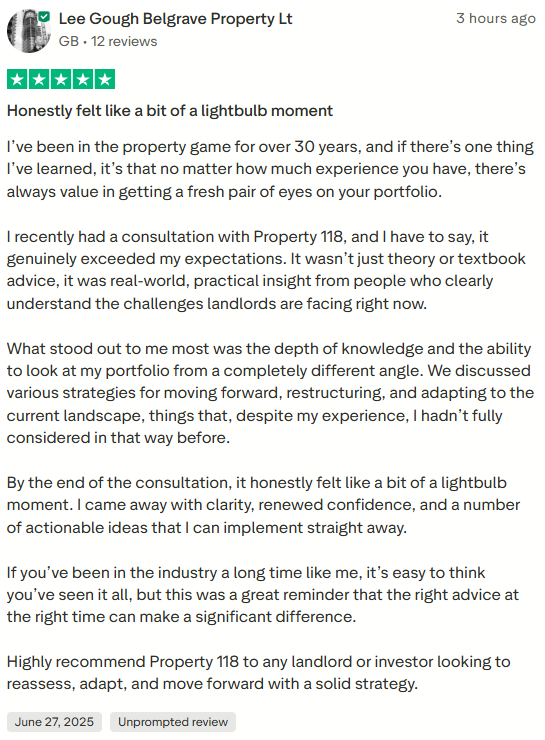
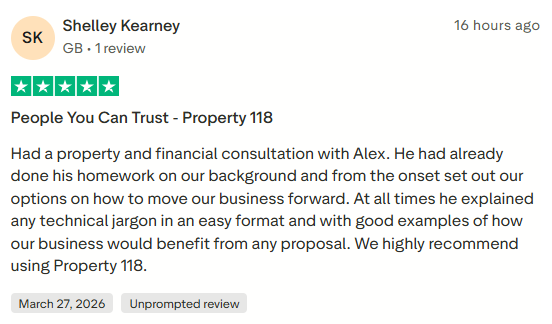
Help other landlords find Property118If you have found Property118 useful, a short Trustpilot review would make a meaningful difference. It helps other landlords decide whether our research is worth following. |
Have Your Say
Every day, landlords who want to influence policy and share real-world experience add their voice here. Your perspective helps keep the debate balanced.
Not a member yet? Join In Seconds
Login with


Previous Article
Buy to let mortgage costs climb 64% in 10 years