

1) When the portfolio is built, what comes next?


Most experienced landlords can remember the early years of building their portfolio very clearly. The focus was simple: find good properties, secure sensible finance, and build momentum. Over time, the portfolio grew, the rents strengthened, and the balance between debt and equity gradually improved. But for many readers of Property118, that journey has now reached a very different stage.
The portfolio is established, borrowing is modest (often well below 40% loan-to-value), and rental income comfortably covers costs. The intense pressure of acquisition and refinancing has largely passed.
From the outside, that looks like success, yet something interesting often happens at precisely this point: the questions begin to change.
The quiet shift from building to thinking
During the growth phase of a property business, the decisions are relatively straightforward. Landlords focus on acquisition opportunities, finance availability, and maintaining healthy cash flow. However, once a portfolio becomes mature, the challenges are less obvious. Many landlords find themselves in a position where the business is performing well, but the portfolio’s long-term direction has never been examined with the same level of detail as the early acquisition strategy. This is not unusual. Most investors spend years thinking about how to build a portfolio; far fewer spend time thinking about what the next twenty or thirty years might look like once the portfolio is already built.
The questions that tend to appear later
Landlords with established portfolios often begin to encounter a different set of questions. They are not usually about buying another property. They are more likely to involve issues such as how the portfolio should evolve over time, whether borrowing levels still make sense, and how the assets will ultimately be managed in later life. Some landlords start thinking about the role their children might play in the business. Others begin considering how to create liquidity without disrupting a stable portfolio.
None of these questions are urgent in the same way that refinancing deadlines or acquisition opportunities can be, and for that reason they are often postponed. The portfolio continues operating successfully, so there appears to be no immediate need to step back and reconsider the broader strategy.
When success creates complexity
Ironically, the more successful a portfolio becomes, the more strategic choices begin to appear. A landlord with two or three properties has relatively limited options, whereas a landlord with fifteen or twenty properties, substantial equity, and modest borrowing suddenly has many possible directions.
Should the portfolio remain exactly as it is?
Should borrowing levels be adjusted over time?
Should ownership structures evolve as families grow and circumstances change?
How should the business be managed if the original owner eventually wishes to step back?
There is rarely a single correct answer to these questions because every portfolio is different, and every landlord has different priorities. Yet the moment many investors pause to consider these issues properly, they often realise that the strategy which built the portfolio may not necessarily be the same strategy that guides the next phase.
A conversation many landlords eventually have
Over the past year we have spoken with an increasing number of Property118 readers who have reached this stage.
Interestingly, those conversations are rarely about buying more property; they tend to focus instead on how an established portfolio might evolve over the long term.
Each conversation begins in the same place: understanding the facts of the portfolio itself.
BOOK A CONSULTATION
These conversations tend to be most useful for landlords with established portfolios and relatively modest borrowing who are beginning to reflect on how their assets could work differently in the years ahead.
|
★★★★★
|
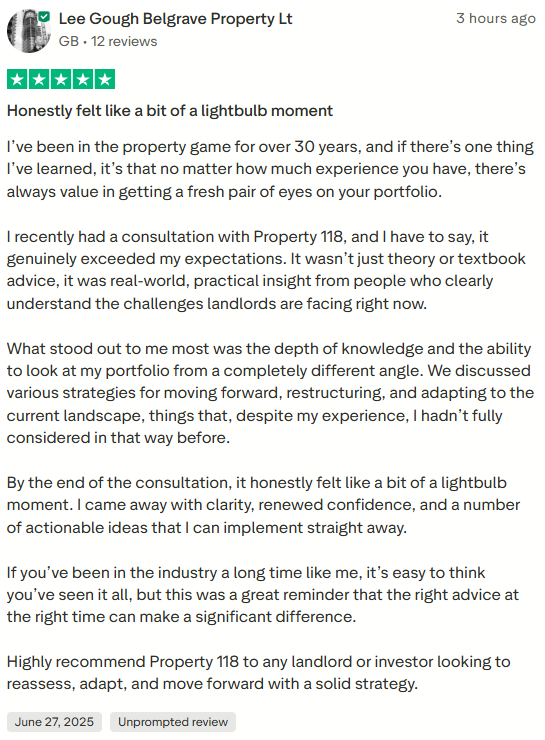
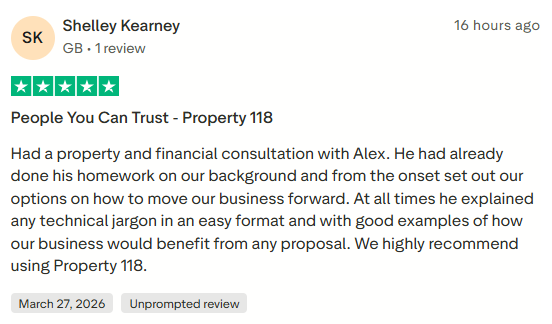
Help other landlords find Property118If you have found Property118 useful, a short Trustpilot review would make a meaningful difference. It helps other landlords decide whether our research is worth following. |
Be the first to comment
Your experience could help the next reader
Have you dealt with something similar? Share what you learned, raise a question or offer a perspective your peers may find useful.
Not a member yet? Join In Seconds
Login with