

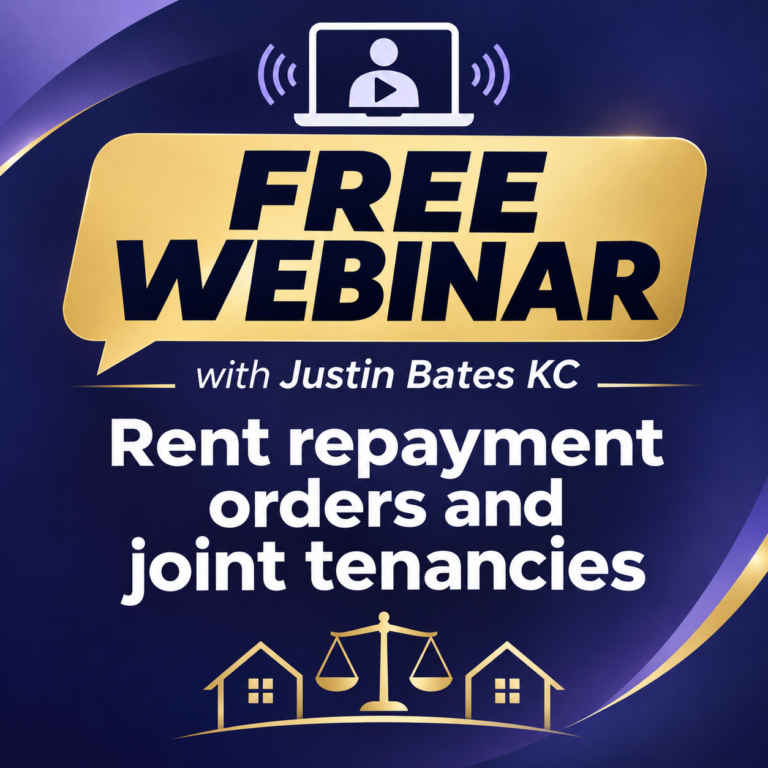
Free webinar with Justin Bates KC on rent repayment orders and joint tenancies

Three former tenants of an unlicensed HMO applied for rent repayment orders. The First-tier Tribunal refused to make the orders because other tenants who had shared their joint tenancies hadn’t joined in. The tenants appealed and won.
On Thursday 26 November at 10.00 am, I’ll be discussing this decision in a free webinar with Justin Bates KC, who acted for the tenants on appeal.
What did the Upper Tribunal decide?
In Ebony Brown & Ors v Nyack Semelo-Shaw [2026] UKUT 448 (LC), the Upper Tribunal confirmed that a joint tenant can apply for a rent repayment order in their own right.
They can claim the rent they can show they paid, including where they paid their share through another tenant who passed it on to the landlord.
This joins other recent changes to the Rent Repayment Order process, such as those brought in by the Renters Rights Act 2025.
What has changed under the Renters’ Rights Act?
For offences committed on or after 1 May 2026, the maximum award in England has increased from 12 months’ rent to two years’ rent.
Tenants also have two years to apply, up from 12 months.
Although the previous limits still apply to offences committed wholly before 1 May, and there are transitional rules for continuing offences that span that date.
The Act also added three new offences that can give rise to a rent repayment order under section 16J of the Housing Act 1988.
- Knowingly or recklessly misusing a possession ground where the tenant surrenders within four months without a possession order.
- Breaching the restrictions on reletting or marketing the property after using the grounds for moving in or selling.
- Continuing certain breaches of the tenancy reform rules beyond the statutory period after a relevant financial penalty.
The Act makes provision for further offences linked to the landlord redress scheme and the Private Rented Sector Database.
A free webinar with Justin Bates KC
Justin will explain why the Upper Tribunal reached its decision and what it means for landlords.
I’ve also asked him to explain how joint tenancies work more generally, including joint and several liability and how notices are served. He’ll answer questions if time permits.
Book your free place for Thursday 26 November at 10.00 am. There is no charge or obligation.
Tessa Shepperson.
Tessa is a specialist landlord and tenant lawyer and runs the Landlord Law online information service at www.landlordlaw.co.uk. You can sign up to her free weekly bulletin (and get a free ebook) at www.landlordlaw.co.uk/bulletin. She also has a Free Daily Tips service.
Be the first to comment
Your experience could help the next reader
Have you dealt with something similar? Share what you learned, raise a question or offer a perspective your peers may find useful.
Not a member yet? Join In Seconds
Login with