

25) Why simplifying a portfolio can sometimes reduce control


There comes a point where many landlords begin to think about simplifying their portfolio; fewer properties, fewer decisions, less complexity.
On the surface, it feels like a natural step, and after years of building and managing a portfolio, the idea of making things simpler is understandably appealing.
Simple, however, does not always mean the same as better.
What simplification usually involves
In practical terms, simplification often means reducing the number of moving parts. Selling properties, paying down borrowing, or consolidating holdings into a smaller, more manageable structure. Each of these steps can make the portfolio feel easier to oversee because there is less to think about and less to manage on a day-to-day basis.
What can change as a result
When a portfolio becomes simpler, something else often changes at the same time; the range of options available to the landlord can narrow.
With fewer assets, there may be fewer ways to adjust income, respond to opportunities or manage changing circumstances.
The portfolio may feel easier to run, but it may also become less flexible.
The trade-off that is not always obvious
This is where the distinction becomes important. Simplification can reduce complexity, but it can also reduce control. Control in this context is not about day-to-day management. It is about the ability to shape outcomes over time; the ability to make different choices when circumstances change.
Why this question often arises later
During the growth phase of a portfolio, the focus is on expansion. Complexity increases naturally as more properties are acquired and managed. Only later, once the portfolio is established, does the idea of simplification begin to surface. It is often driven by a desire for clarity and ease rather than necessity.
Looking at the portfolio from a different angle
At this stage, it can be helpful to look at the portfolio not just in terms of how easy it is to manage, but how it behaves as a whole: what options it creates, how it responds to change, and what degree of flexibility it allows.
These are not always visible when the focus is purely on reducing complexity.
A question worth pausing on
Before making any move towards simplification, it can be useful to consider one simple point: What might you be giving up in exchange for making things simpler?
For some landlords, the answer is clear and the trade-off is worthwhile. For others, it is a question that has never been examined closely.
An invitation for established landlords
If you are considering simplifying your portfolio, or have already begun to do so, it may be worth taking a step back and looking at the wider picture.
BOOK A CONSULTATION
From there, we can arrange a discussion to explore how your portfolio is structured and what that might mean for your future options.
|
★★★★★
|
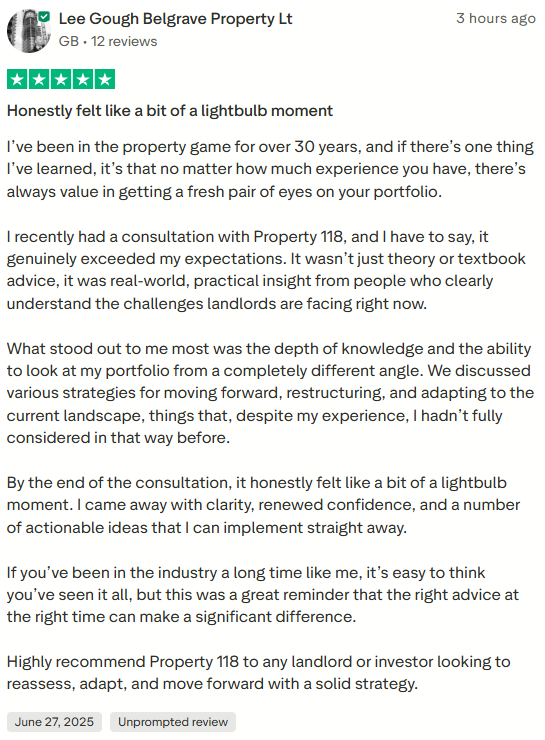
Help other landlords find Property118If you have found Property118 useful, a short Trustpilot review would make a meaningful difference. It helps other landlords decide whether our research is worth following. |

Be the first to comment
Your experience could help the next reader
Have you dealt with something similar? Share what you learned, raise a question or offer a perspective your peers may find useful.
Not a member yet? Join In Seconds
Login with